A major stratospheric warming event is now officially underway, with a complete wind reversal and a full split of the Polar Vortex. The initial impacts are already appearing in the short-range forecasts, with a massive low-pressure area over Canada beginning to reshape the weather across the United States and parts of Europe.
But the latest forecast data confirms a larger second impact starting later next week, as a rare early-spring Polar Vortex core is forecast to drop into the United States. This atmospheric breakdown is expected to bring unseasonably low temperatures and disrupt the seasonal transition, as the broken core migrates southward from the polar circle.
In this article, we will first look at the current stratospheric warming event and the resulting Polar Vortex split. Also, we will analyze the complex atmospheric dynamics that are allowing a proper Polar Vortex core to descend into North America during the late-winter and early-spring period.
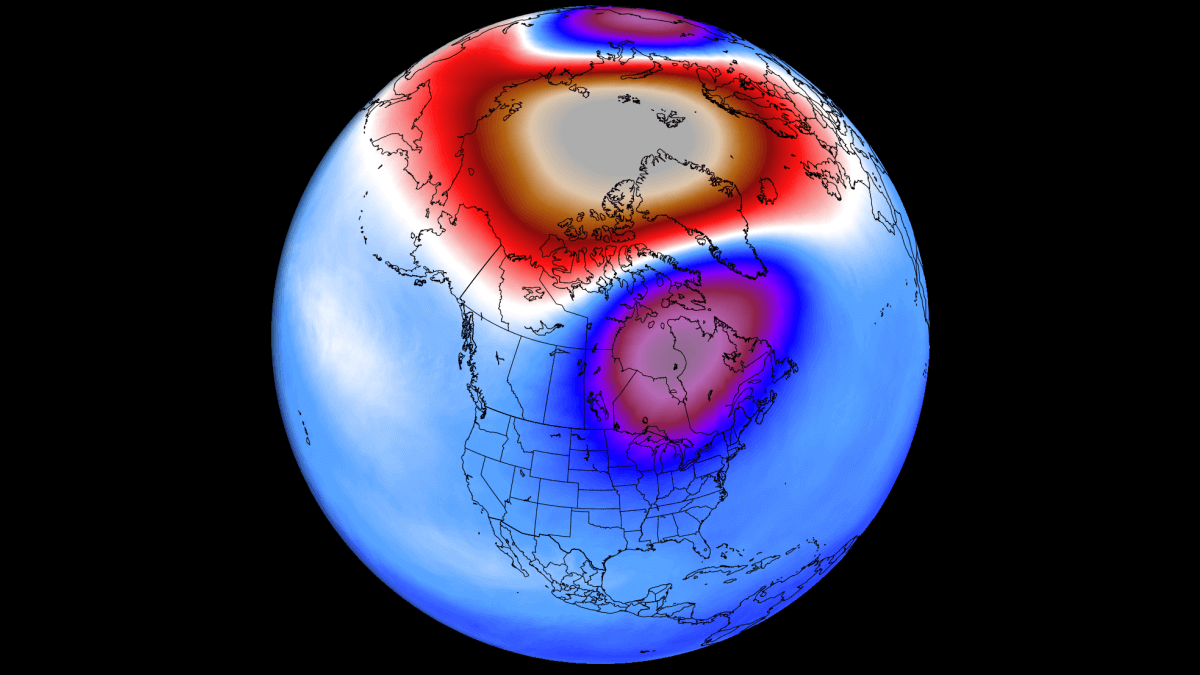
Polar Vortex: The Strong High-Altitude Winter Engine
Our main objective is to share weather information and forecasts, and to discuss less-known atmospheric or oceanic anomalies. But at the same time, we want to explain complex weather phenomena, like the Polar Vortex, in simple terms so everyone can understand what is occurring in our atmosphere.
In simple terms, the Polar Vortex is a broad winter circulation over the northern (and southern) hemispheres. You can imagine the Polar Vortex as a spinning wall over the polar regions, rising from the surface into the stratosphere (over 50km/30 30miles high), trapping the cold polar air inside.
The Polar Vortex is divided into two layers: the stratosphere (at higher altitudes) and the troposphere (at lower altitudes). These two layers are interconnected but often behave differently. A strong, stable Polar Vortex acts like a barrier, locking the coldest air into the North Pole, creating milder conditions for the United States and Europe.
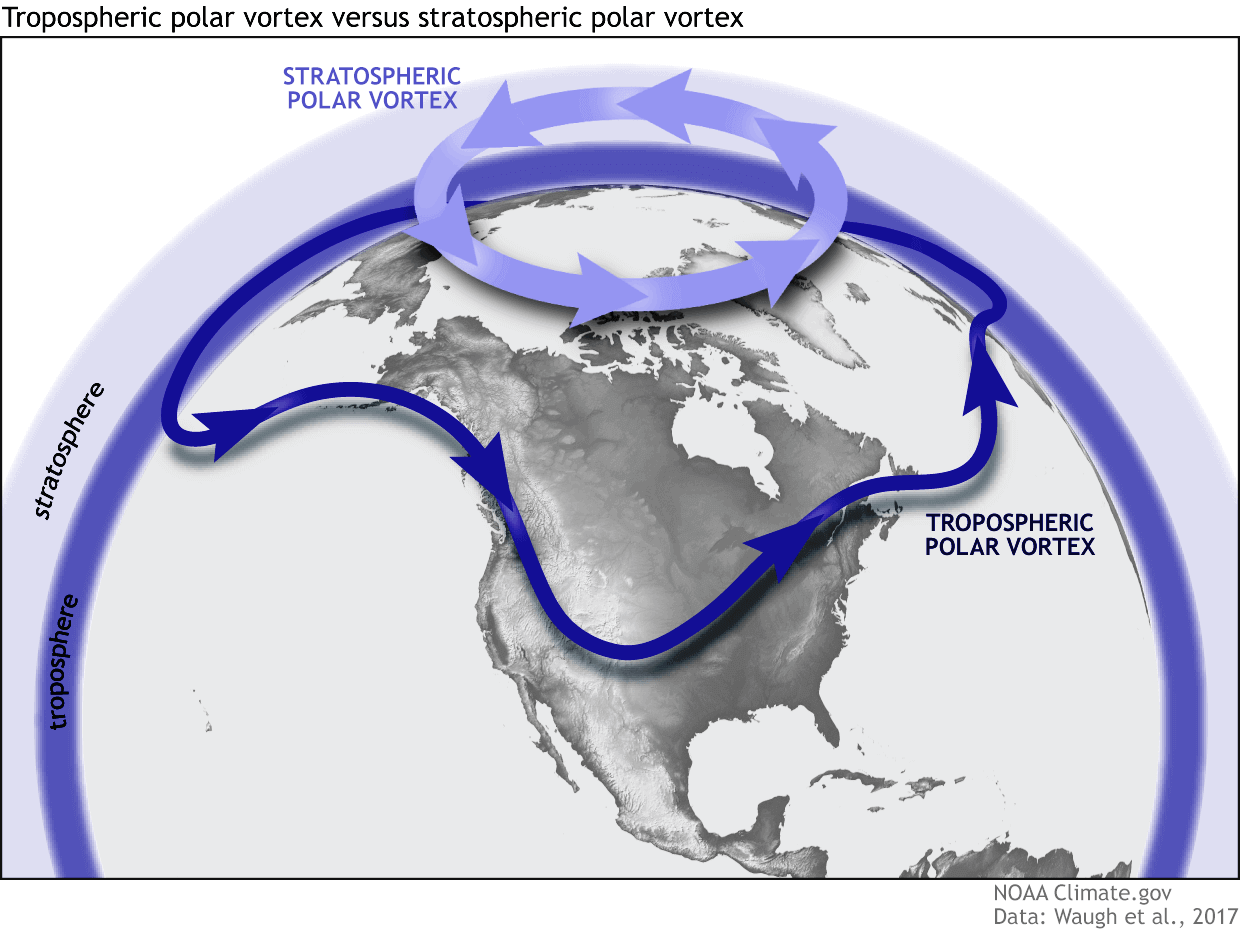
When the Polar Vortex is disrupted or “collapses,” this polar barrier breaks, allowing cold Arctic air to spill southward into the mid-latitudes. However, as we move into late winter, the dynamics start to change, and the Polar Vortex naturally weakens as the polar regions receive more sunlight. Below is an example from NOAA of how a disrupted Polar Vortex releases cold polar air into the United States or Europe.
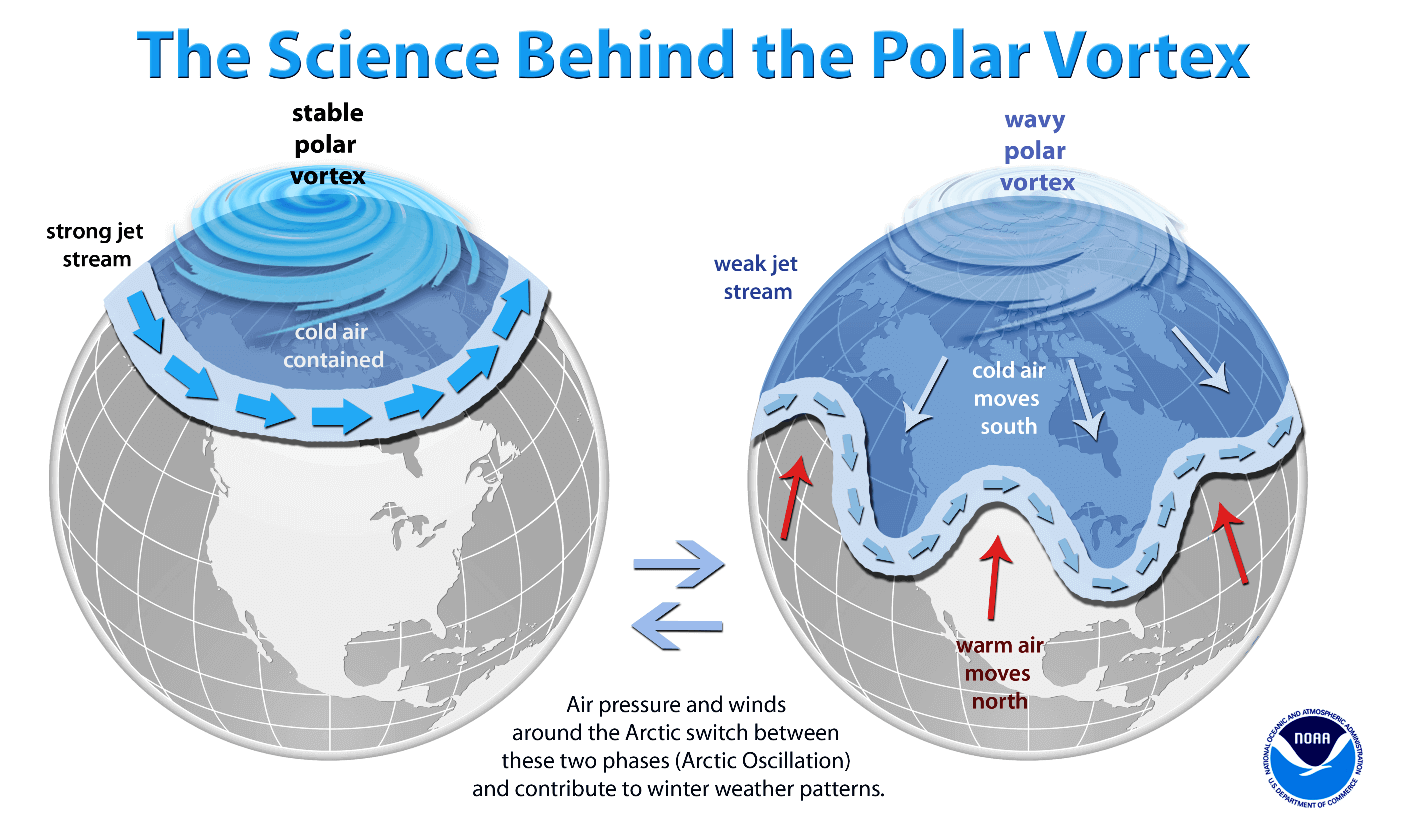
If you like cold winter weather across the United States, Canada, or Europe, this weak/disrupted Polar Vortex is exactly what you want to see. But a disrupted Polar Vortex does not guarantee cold in every single area of the mid-latitudes.
The disruption usually arises from a rise in stratospheric pressure and temperature, known as a Stratospheric Warming (SSW) event, or from other dynamics that can originate from the lower levels.
To show the Polar Vortex in its true form, we produced a high-resolution video below that reveals its 3D structure. This video shows the current disruption of the Polar Vortex structure from a Stratospheric Warming event, and its evolution into early Spring.
The current stratospheric warming event is a major category, as it came with a proper wind reversal and a full split of the Polar Vortex core.
Polar Vortex Split: A Major Stratospheric Warming Event Unfolding
The most common way we monitor the Polar Vortex is by looking at wind speeds around the polar circle. A strong positive (westerly) wind indicates stable conditions or a strong Polar Vortex, but weak or even negative (easterly) winds indicate a complete reversal and a breakdown of the Polar Vortex.
Below is the latest analysis and forecast of the mid-stratospheric winds around the Polar Vortex. It shows the GEFS ensemble data, with the Polar Vortex currently in a negative (easterly) mode. This is due to a stratospheric warming event and the split of the Polar Vortex core.
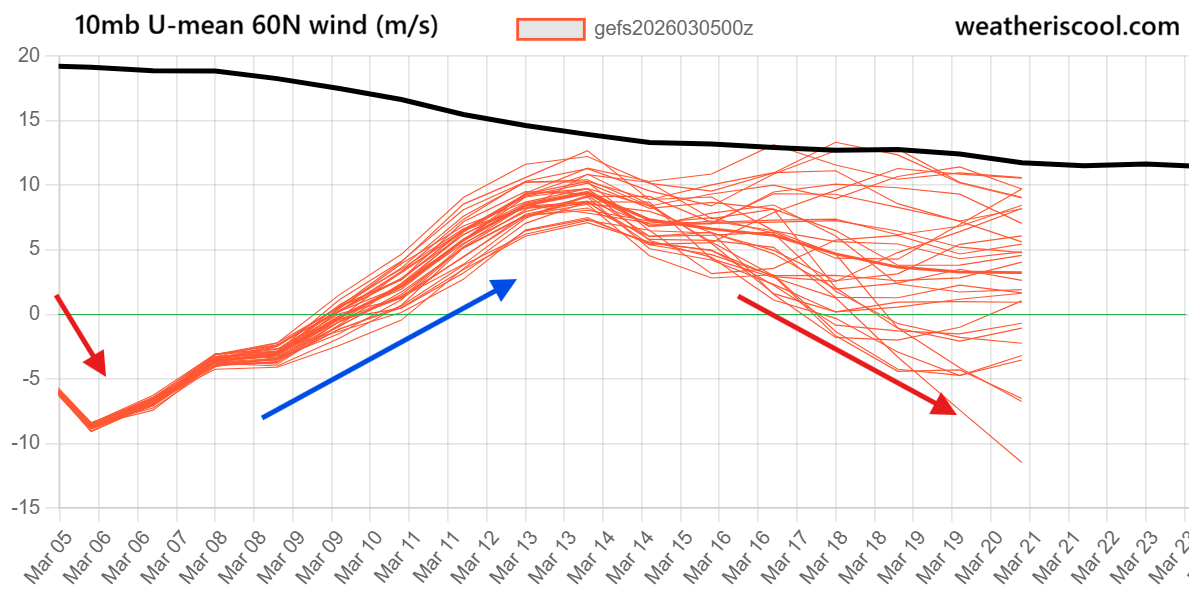
The black line shows the long-term average, so overall, the Polar Vortex is forecast to run well below normal into Spring, especially since we now have a proper wind reversal. The current forecast data shows a proper disruption of the Polar Vortex in the middle and upper Stratosphere.
We also need to look at temperature and pressure maps in the stratosphere, which not only indicate the strength of the Polar Vortex, but also its potential weather impact.
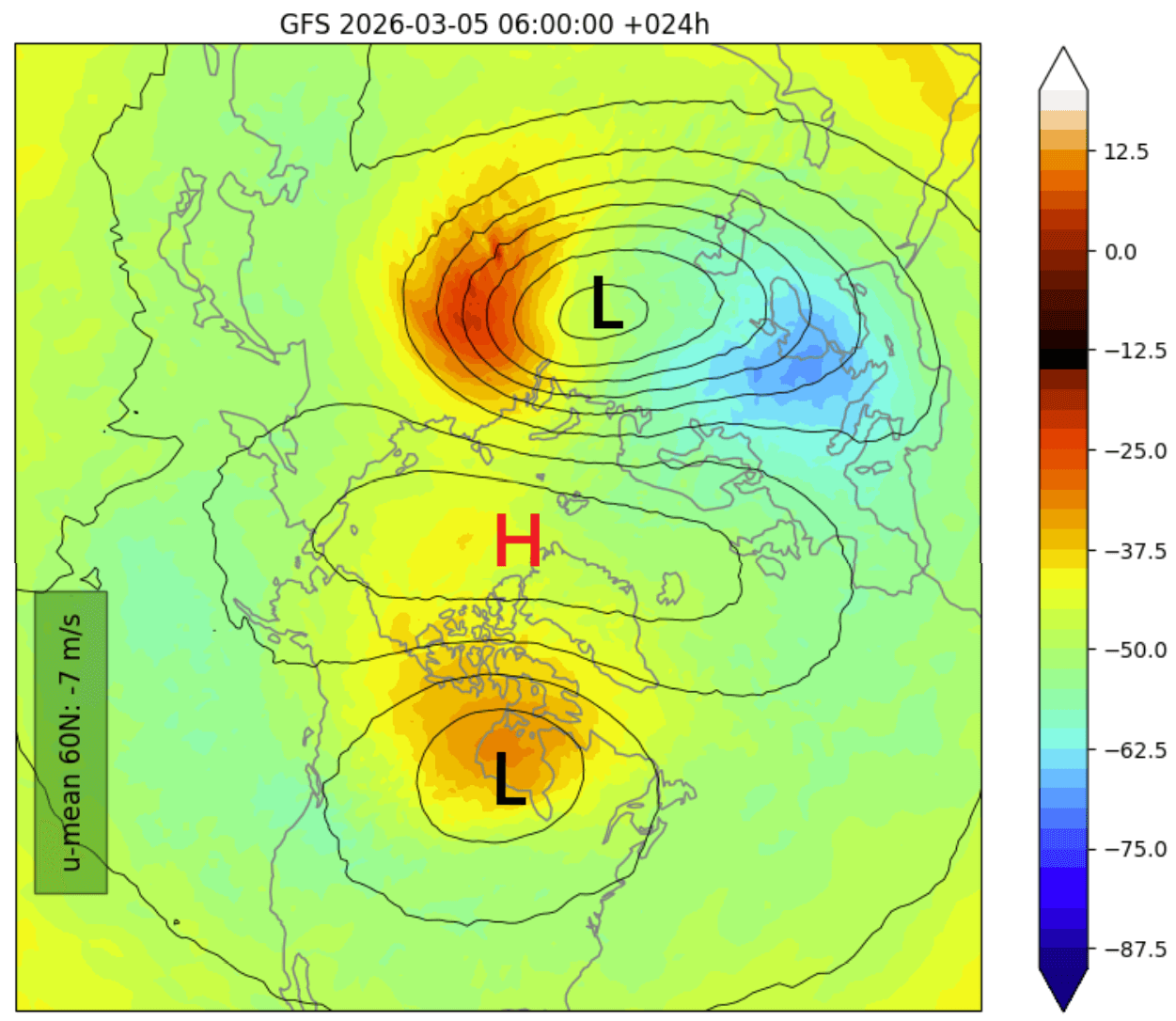
Below is the latest analysis for the mid-stratosphere at the 10mb level (30km/18.5miles height). The Polar Vortex is clearly split into two distinct cores, each with its own warming wave. A high-pressure area dominates the polar stratosphere, also sometimes called an anti-vortex.
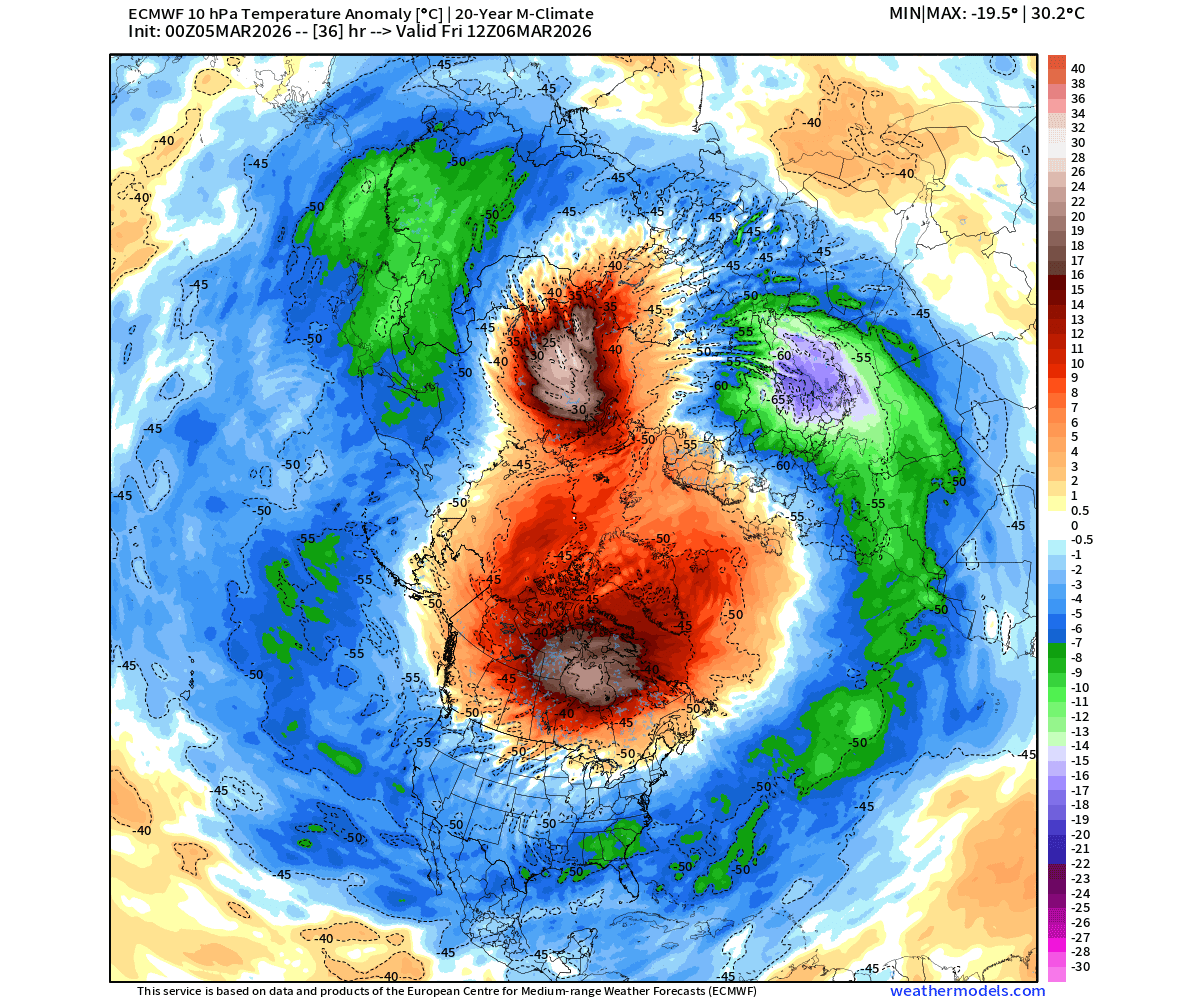
The stratospheric warming anomaly is properly revealed if we look at the temperature map, which shows how much warmer the stratosphere is compared to normal. Below is the current map, which shows a broad polar warming wave in the stratosphere, with temperatures peaking 30 degrees C higher than normal for this time of year.
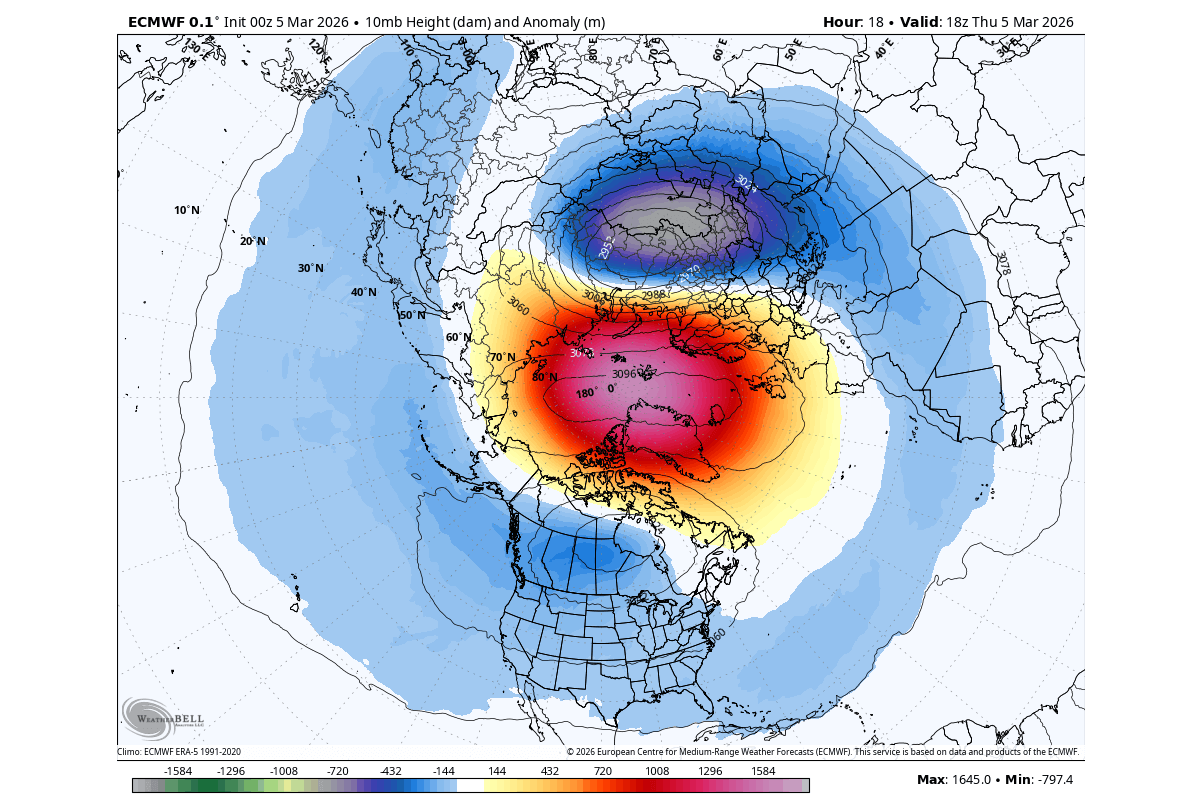
Also, looking at the latest pressure anomaly in the mid-stratosphere, it reveals an impressive high-pressure area at the 10 mb level, breaking the Polar Vortex into two separate cores. This high-pressure anomaly, along with the two displaced cores, causes the wind reversal as an anticyclone spins clockwise, creating easterly (negative) zonal winds.
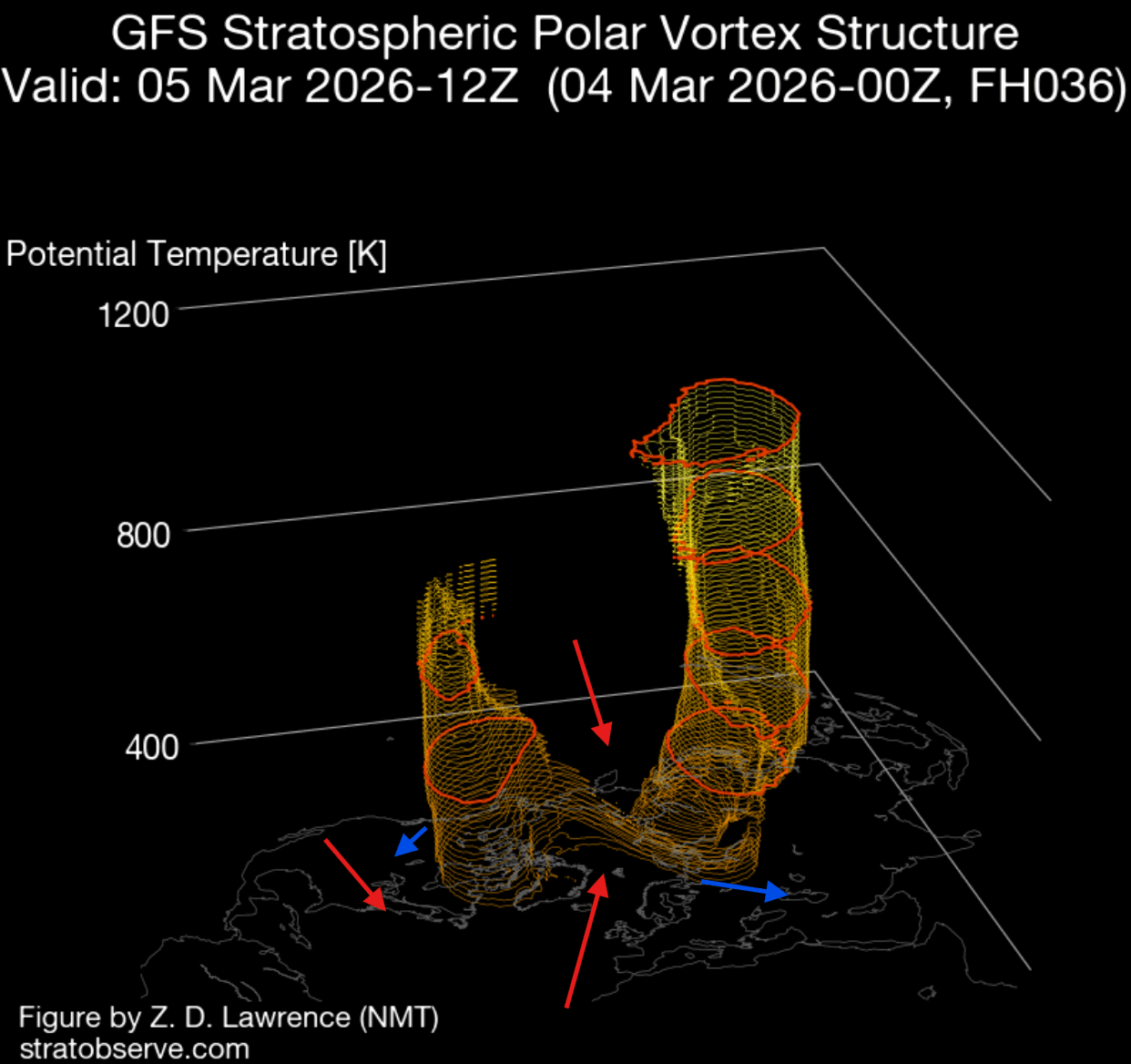
This strong split dynamic is nicely seen in the Polar Vortex 3D analysis below. The stratospheric high-pressure area has separated the Polar Vortex almost to the bottom of the atmosphere. By creating two separate Polar Vortex cores, this brings distinct weather impacts onto the whole Northern Hemisphere, shaping the early Spring weather patterns.
If we were at the peak of Winter, the impact of such a core split would be fantastic for winter fans. But as we are already into the early meteorological Spring, the rules of the game start to change.
The First Wave: Tracking the Initial Lower Atmosphere Disruption
The image below shows the pressure anomaly for the lower stratosphere at the 50mb level (20km/12.4 miles). We see the same high-pressure anomaly over the pole as above, creating two split Polar Vortex cores. The stronger core is displaced towards the North American side, but does not reach deep into the United States, as it could, for example, in mid-Winter.
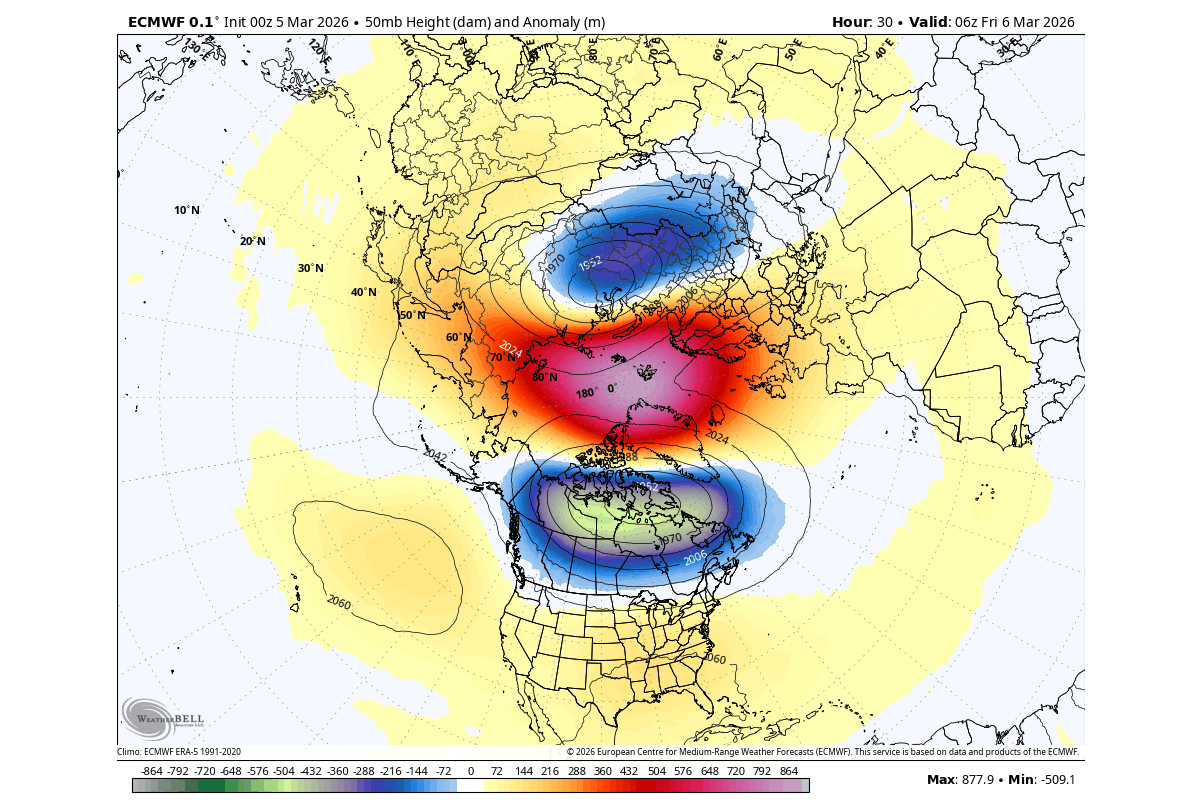
What this does is it impacts how far down the northerly airmass can reach, controlling the potential spread of the cold air. But it also allows a southerly flow over the east.
Looking at lower pressure levels, the day 1-5 forecast below shows a disrupted Polar Vortex pattern, and also indicates two main Polar Vortex core areas, just like in the stratosphere. You can see the main low-pressure area over Canada, connected to the stratospheric core shown in the previous image.
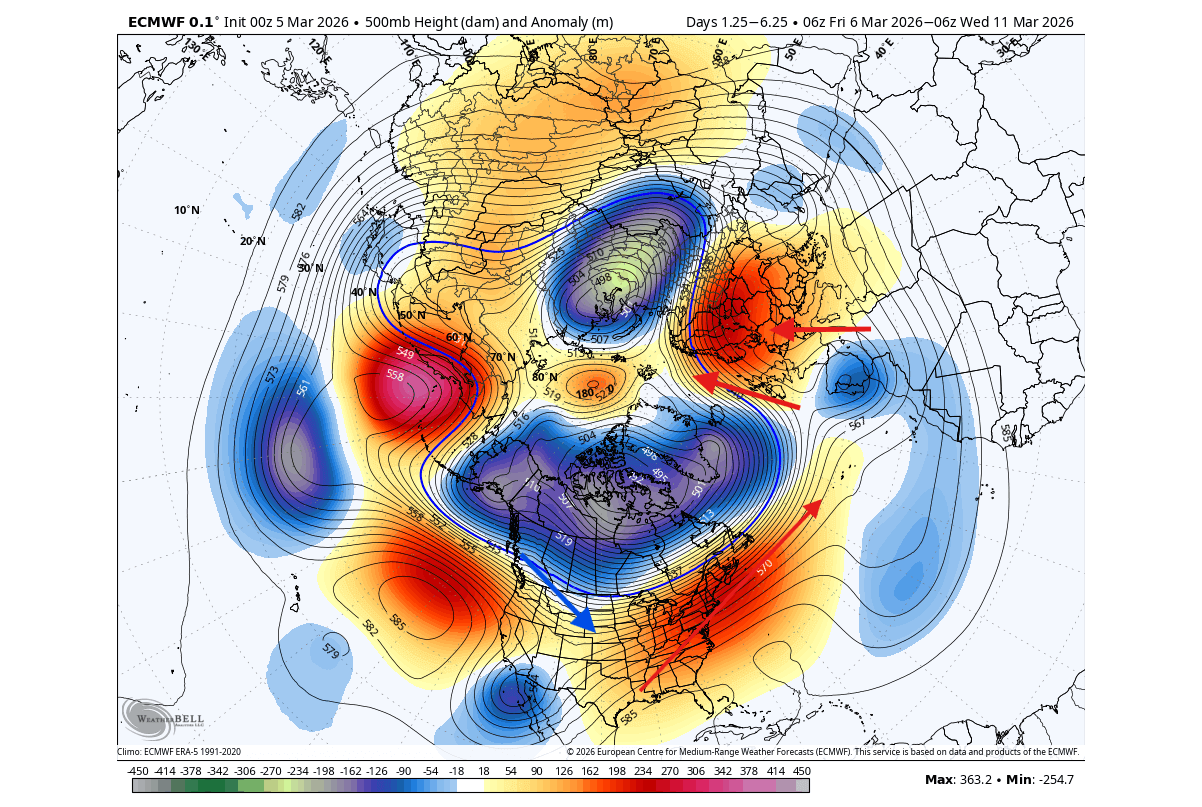
This local Polar Vortex core in such a position has two major weather impacts. First is a more local, bringing a northerly flow into the northern and northwestern United States, and also over the northeast. The secondary effect of such a core is helping to build a high-pressure zone over Europe, creating unseasonably warm conditions.
In the image below, you can see the Winter Storm Severity Index forecast for days 1-3, created from official NOAA data. It shows the coverage of expected winter weather, impacted by the proximity of the Polar Vortex core over Canada. It shows areas of winter weather and minor to moderate impacts across the northern and western parts of the United States, as well as over the northeast.
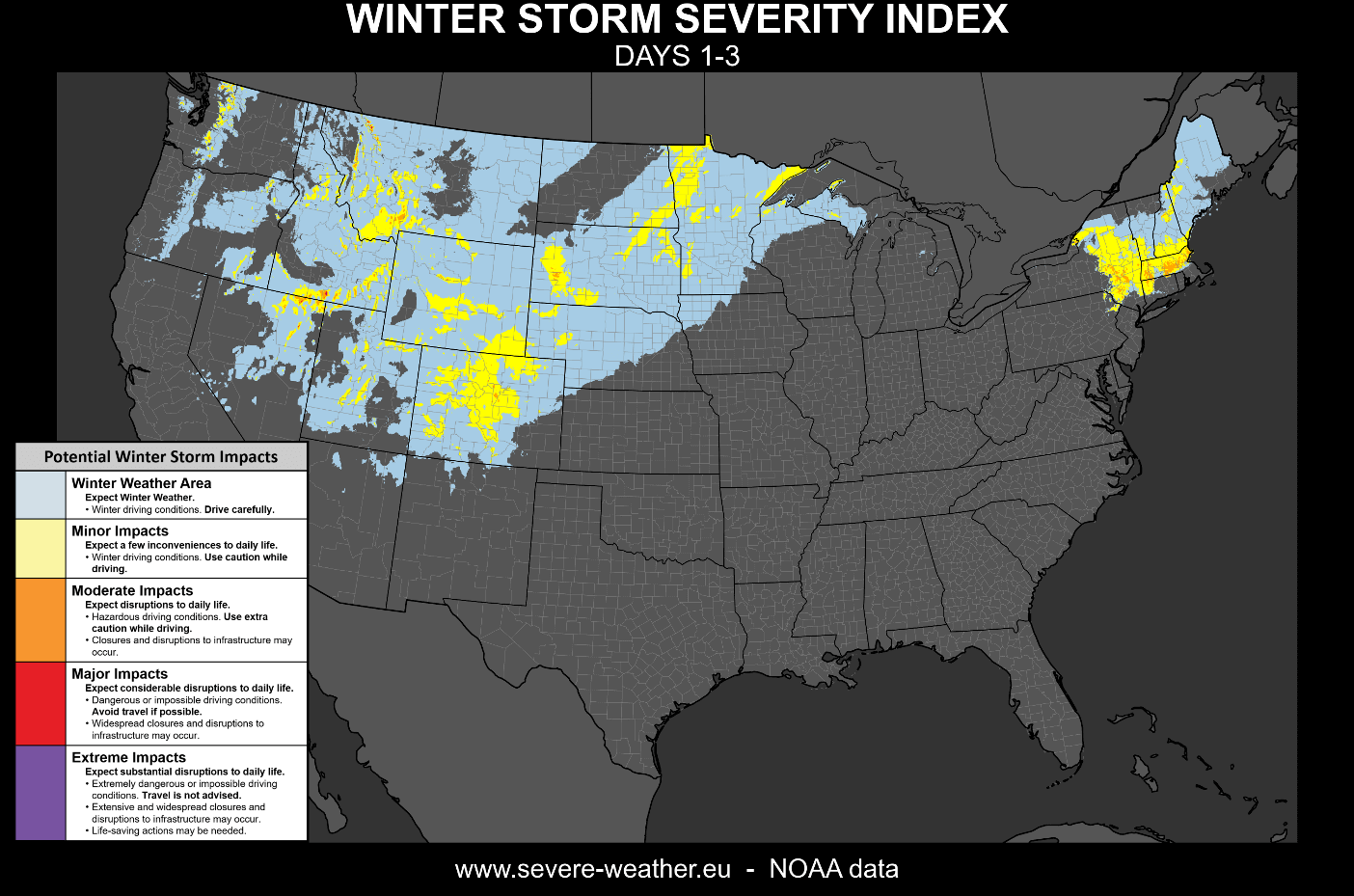
This map nicely shows the widespread impact and winter weather conditions that the proximity of a Polar Vortex core can bring, also seen several times this season already.
The surface temperature forecast for the coming 1-6 days shows a cold air anomaly over Canada. But with the main core of low-pressure over Western Canada, that helps to amplify a higher pressure area over the eastern United States, with a warmer southerly airmass.
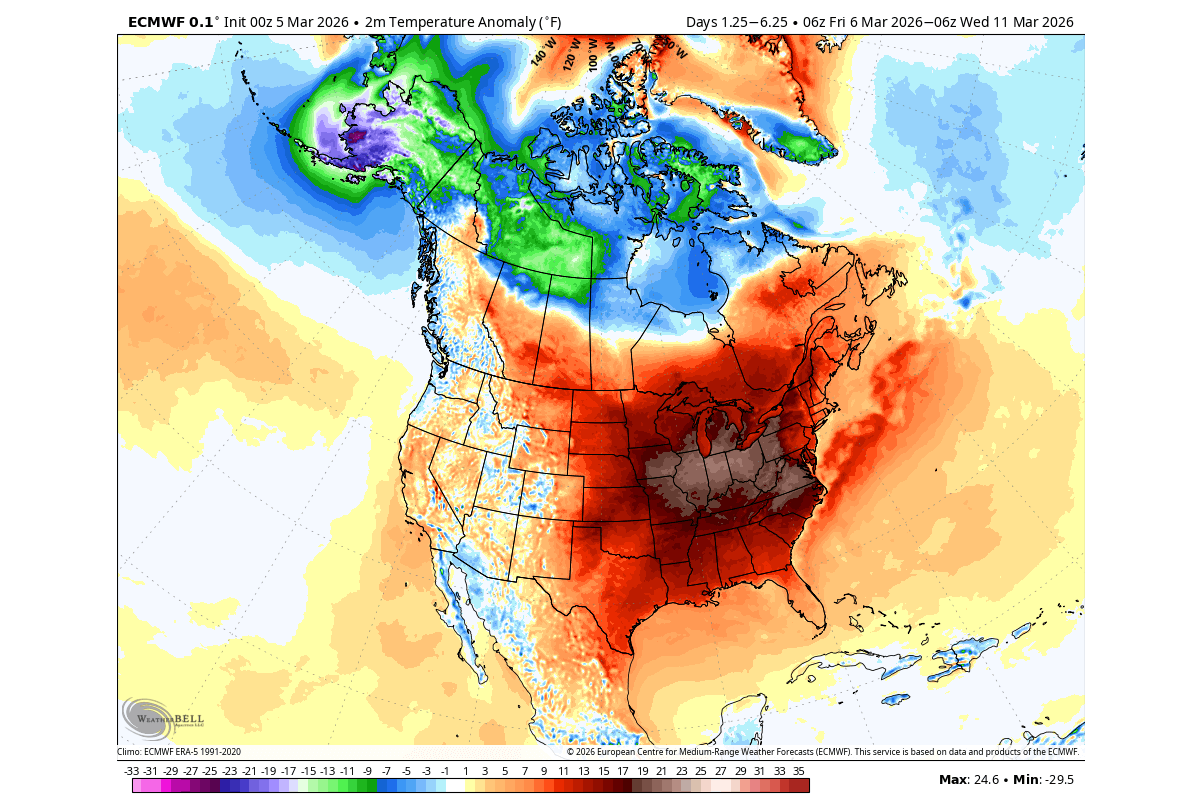
This will bring a period of Spring weather into the central and eastern United States, but it is not forecast to last long, as the second wave of stratospheric impacts is already forecast for late next week.
Looking into Europe for the same period, we mentioned that the Polar Vortex core over North America helps to build a high-pressure area in Europe. The temperature anomaly forecast shows a warmer airmass spreading over the continent in the coming days, with the cold areas further over the northeast, and a cooler airmass over the southeast and southwest under low-pressure areas.
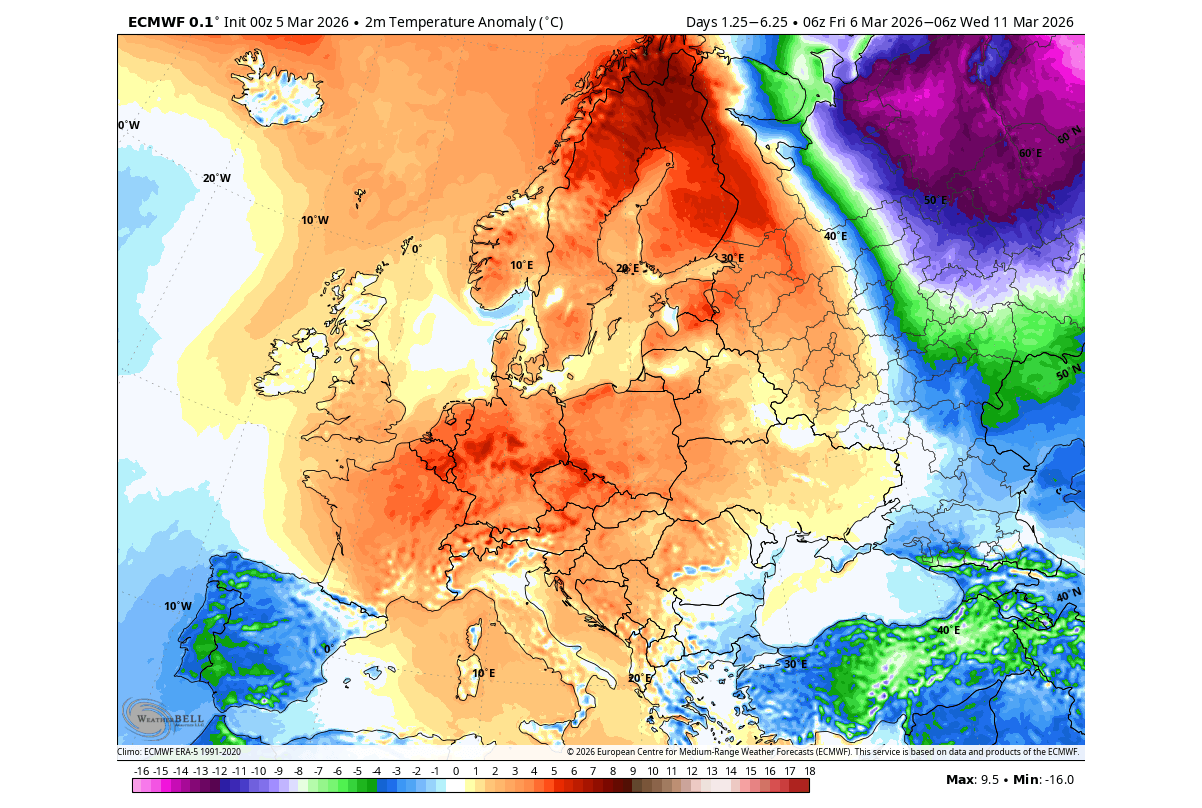
But this is just the initial “jolt” in the atmosphere, following the Polar Vortex split. A more proper, delayed impact from the stratospheric warming is currently forecast for later next week, as a rare early-Spring Polar Vortex core is set to drop into the United States.
Early Spring Cold Anomaly: A Polar Vortex Core Forecast to Descend into the U.S.
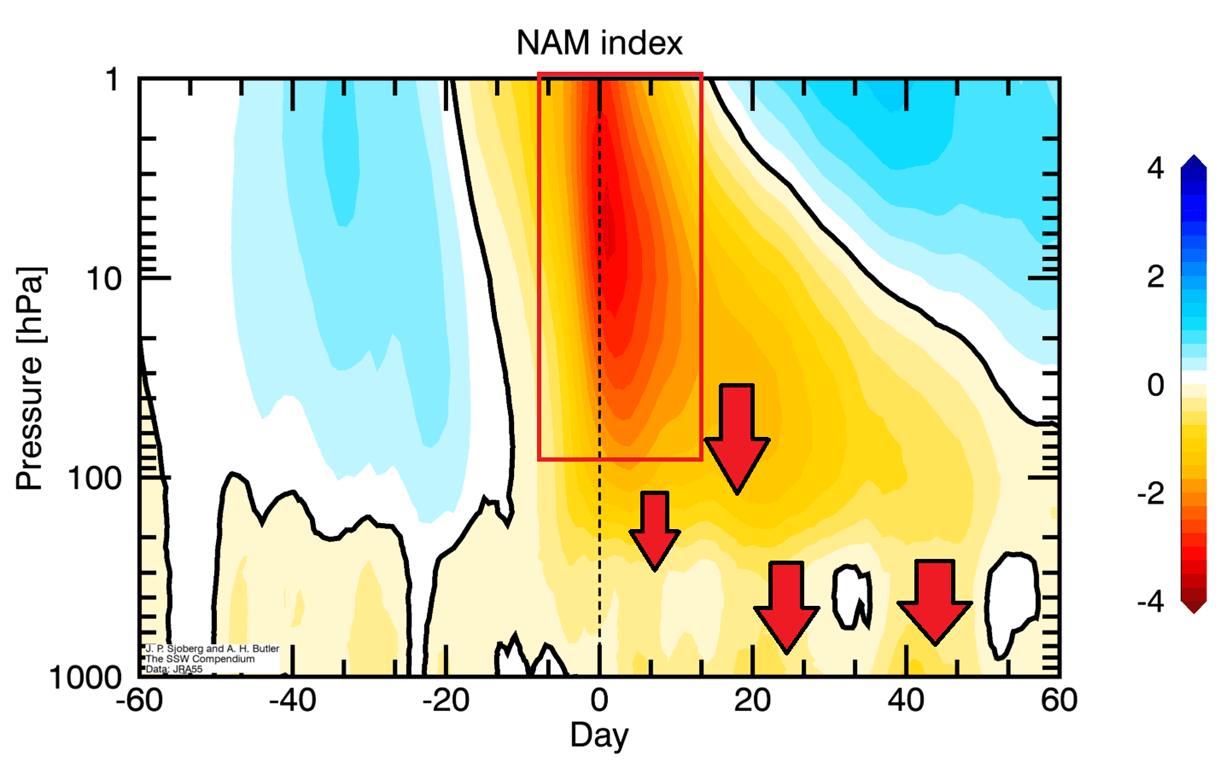
Below is a typical vertical schematic of how a stratospheric warming event works. The image shows pressure anomalies across the atmosphere over the whole SSW event, with 0 being the peak day of the event, or the start of wind reversal. You can see how the main event in the stratosphere affects the surface layers downwards with some delay, usually in the 10-30 day range. Image by NOAA CLS.
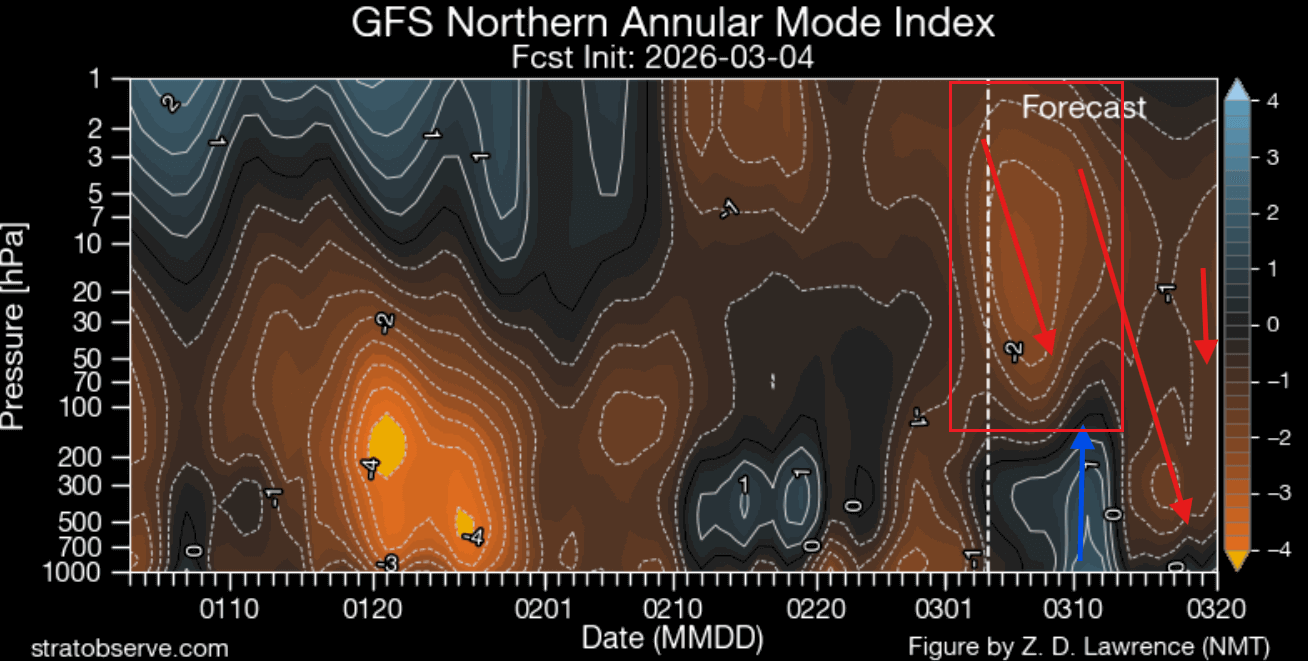
The image below shows a similar vertical structure of the atmospheric pressure anomalies, from the surface up to the top of the stratosphere. In the forecast part, you can clearly see the stratospheric warming event pushing downwards with a high-pressure anomaly. We can see a connection to the lower levels into mid-March, coinciding with the forecast Polar Vortex core late next week. Image by Stratobserve
The pressure anomaly map below shows the weather pattern forecast in the 10-15 day range. You can see the high-pressure areas over Siberia, pushing around and into the polar circle. The main Polar Vortex core is seen descending into the eastern United States, bringing along a colder airmass.
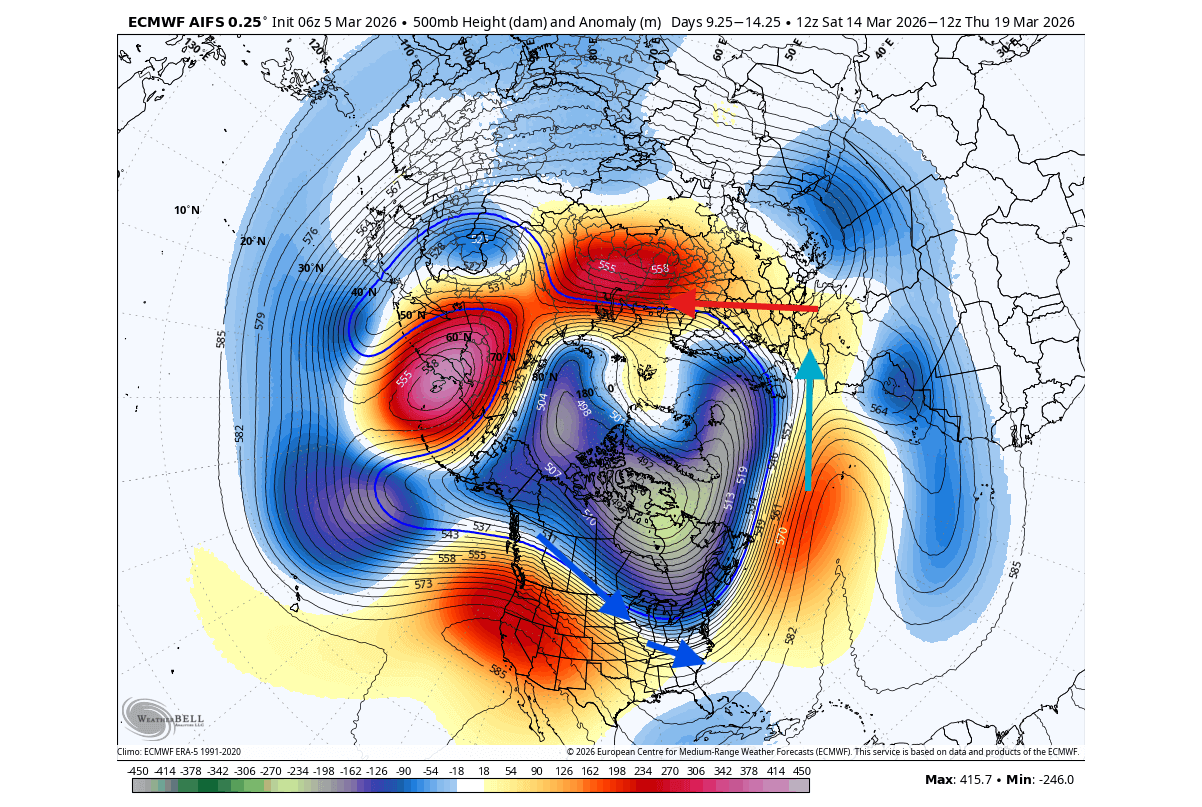
It also amplifies a westerly flow over the Atlantic, bringing a more maritime airmass into the western and central parts of Europe.
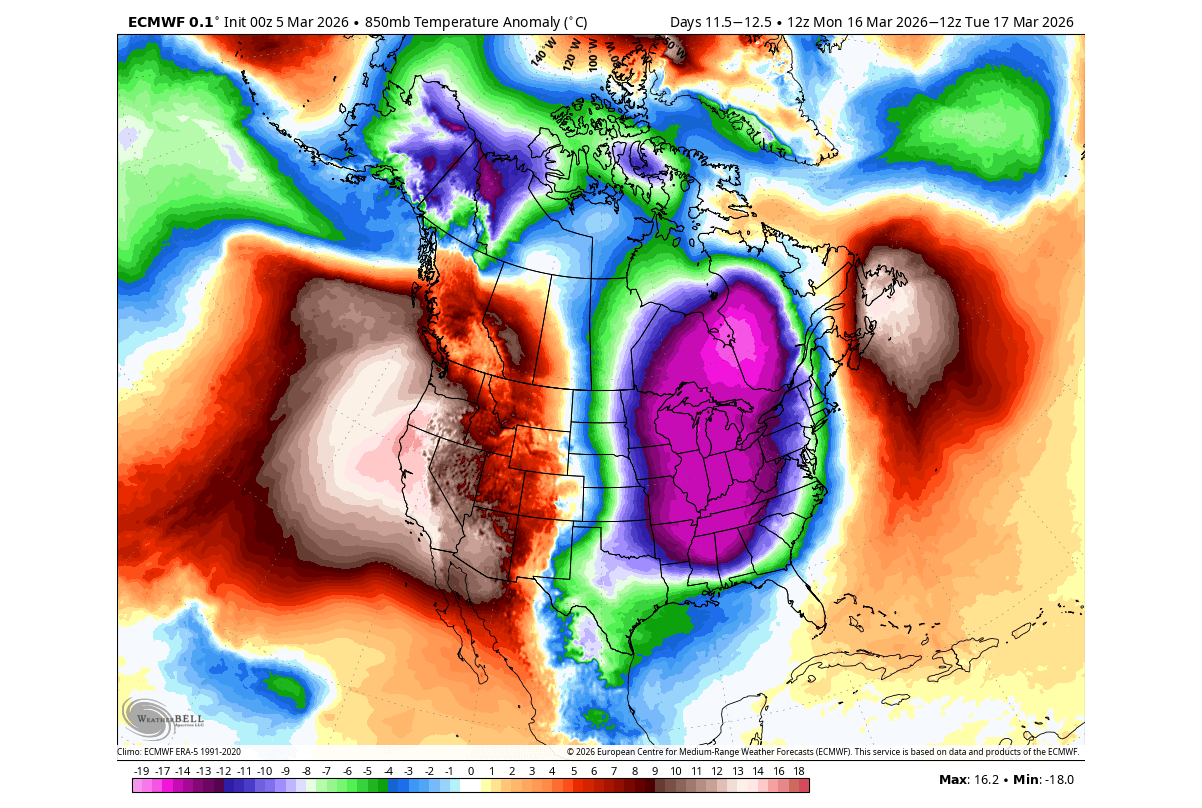
Over North America, the current forecasts are trending for the Polar Vortex core bringing down a cold airmass from the north, spreading across the central and eastern United States. The image below shows the airmass temperature anomaly, at the 850mb level (1.5km/5000ft) in about 10 days.
Looking at the latest surface temperature trends, this shows a large spread of unseasonably cold early spring air across the northern, central, eastern, and southern United States and eastern Canada. The latest forecast shows temperatures 20 to 30 degrees F lower than normal for this time of year, looking like a proper Polar Vortex core event.
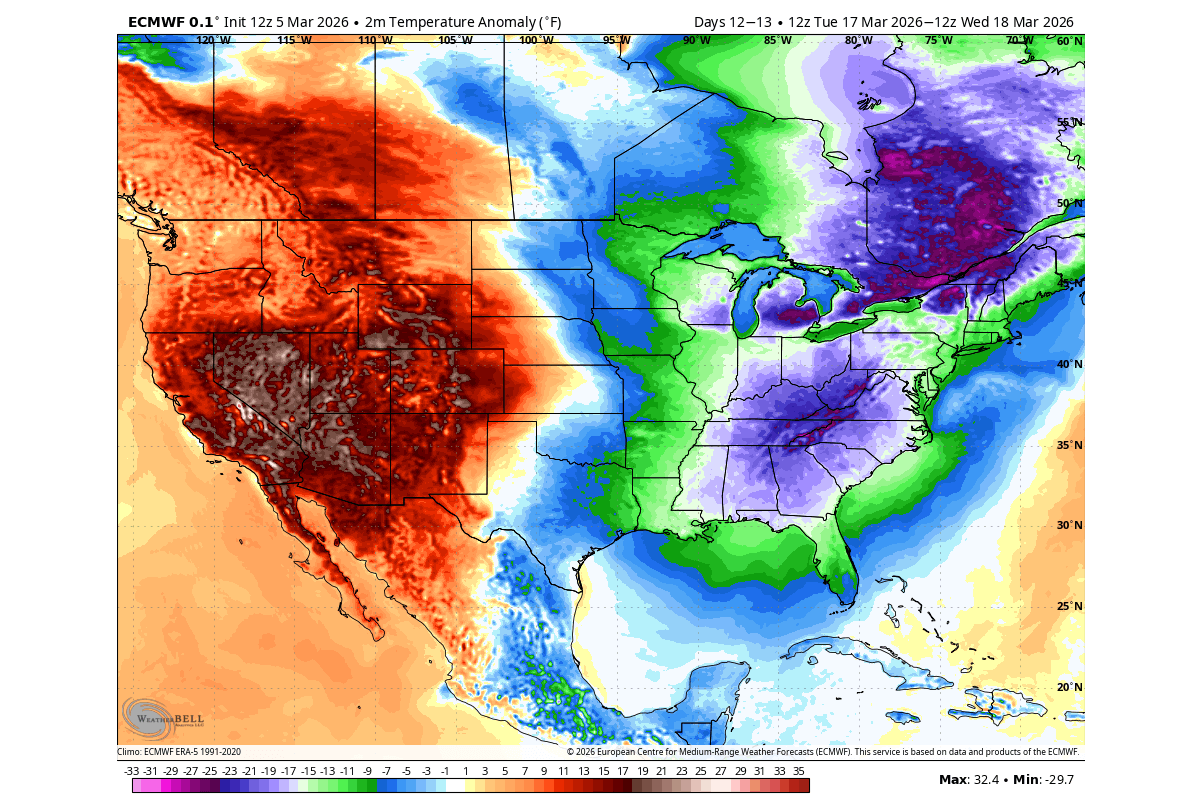
But we do have to add that this is just one model run, as an example of the potential weather outcome in such a Polar Vortex core event.
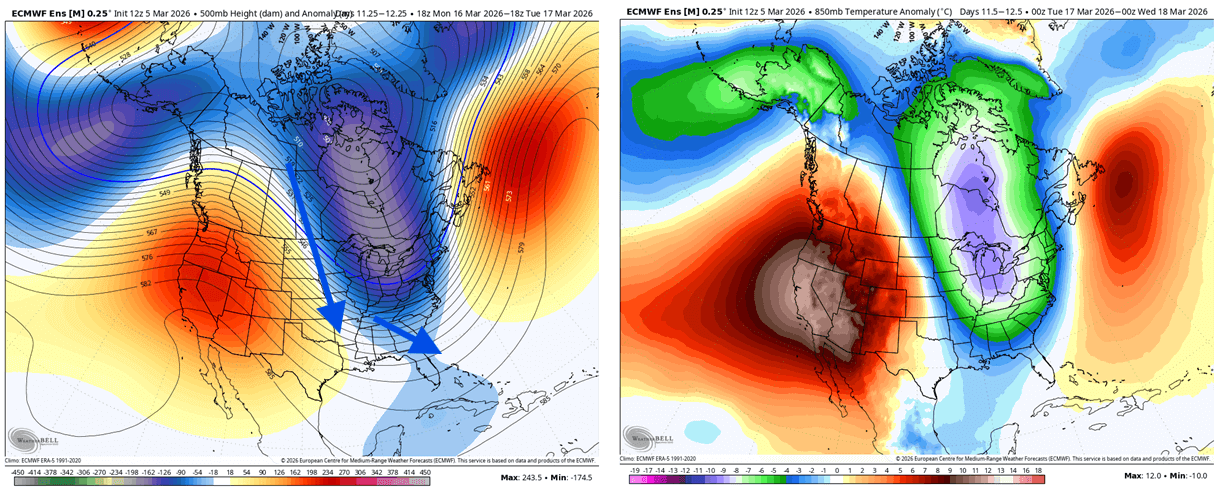
The best way to also confirm the expected development, is to look at the ensemble data, which contains 50 different calculations. You can see the ensemble mean forecast below for pressure and temperature, which also confirms the Polar Vortex core dropping into the United States in around 10 days, bringing along a wave of colder air.
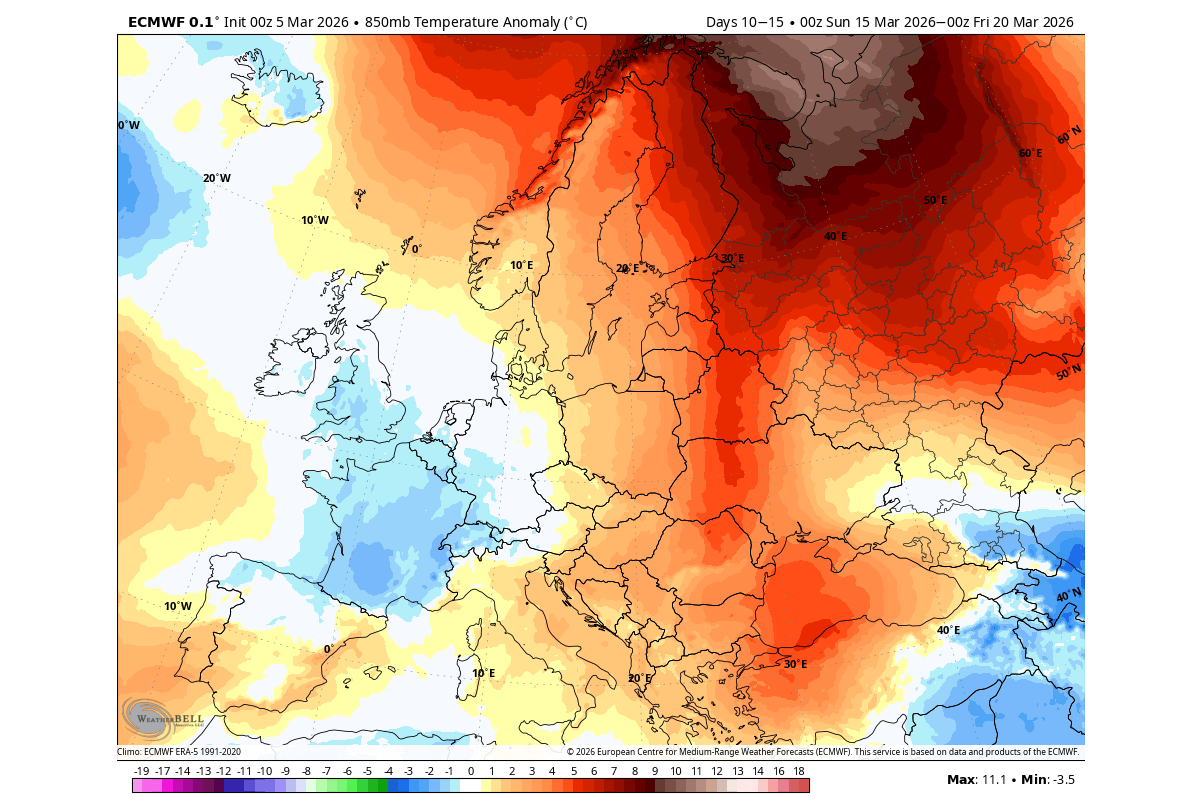
As mentioned before, the Polar Vortex core over eastern Canada and the United States helps to create a more westerly or southerly weather pattern over Europe. That is seen in the temperature forecast for days 10-15 as a cooler flow from the Atlantic, while the bulk of the warm anomalies is pushed further north and east.
We can also have a look at the latest extended trends to see how long the latest forecast data resolves this weather pattern going into the second half of March.
Late March Trends: Evolution of the Post-Collapse Weather Patterns
Looking at the March week 3 forecast, the ECMWF ensemble forecast shows continuation of the split-core pattern and the outgoing Polar Vortex core over eastern Canada. This supports continued northerly flow, but moving further into the eastern and northeastern United States, while a high-pressure area returns to the west.
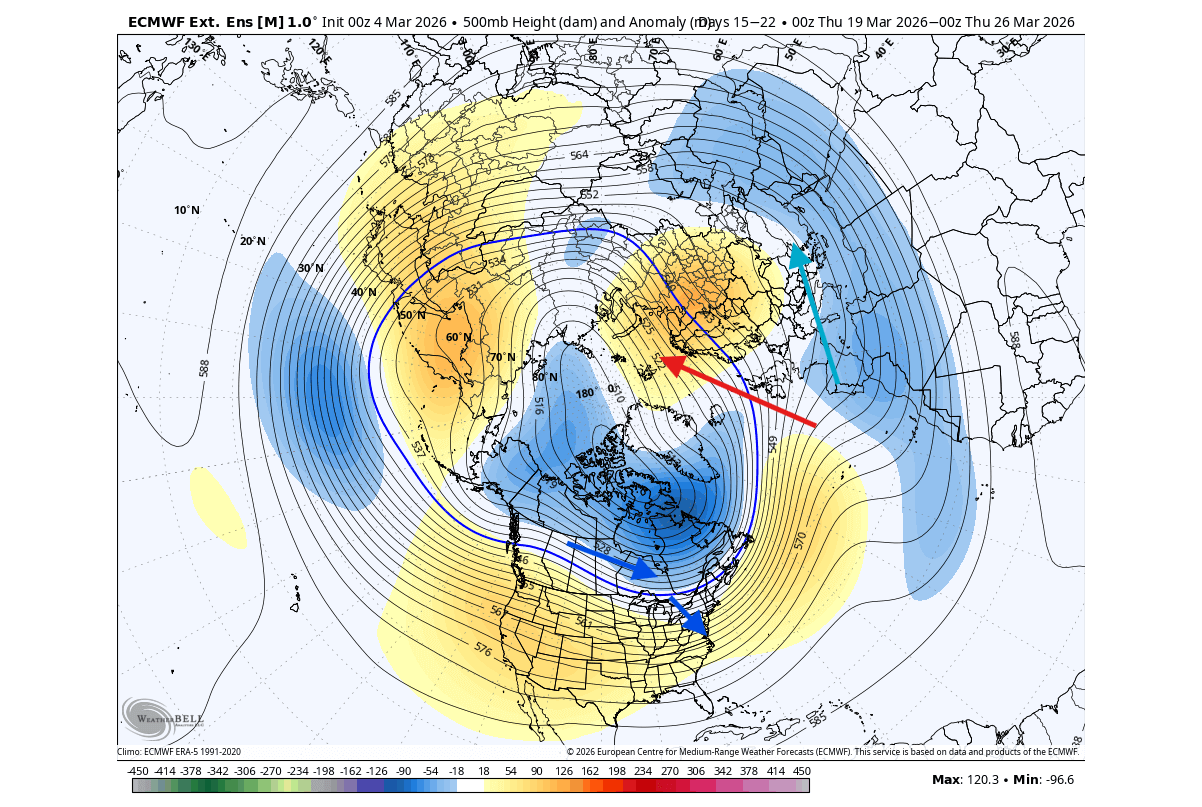
Over Europe, we can see a split flow, with lower pressure over the south and higher pressure to the north and east.
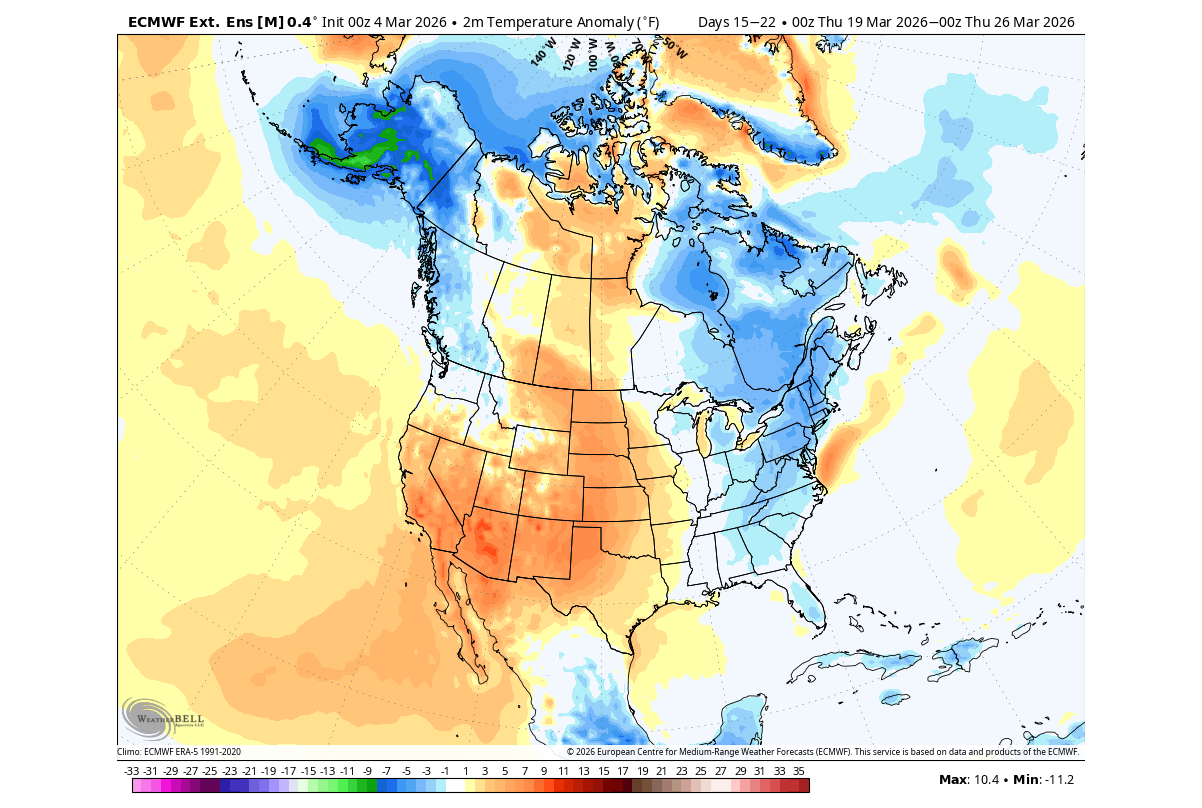
The temperature anomaly forecast for this period shows below-normal temperatures moving, but remaining over eastern Canada and the northern, western, and west-central United States. A warmer airmass is forecast to return into the western and central United States and southwestern Canada.
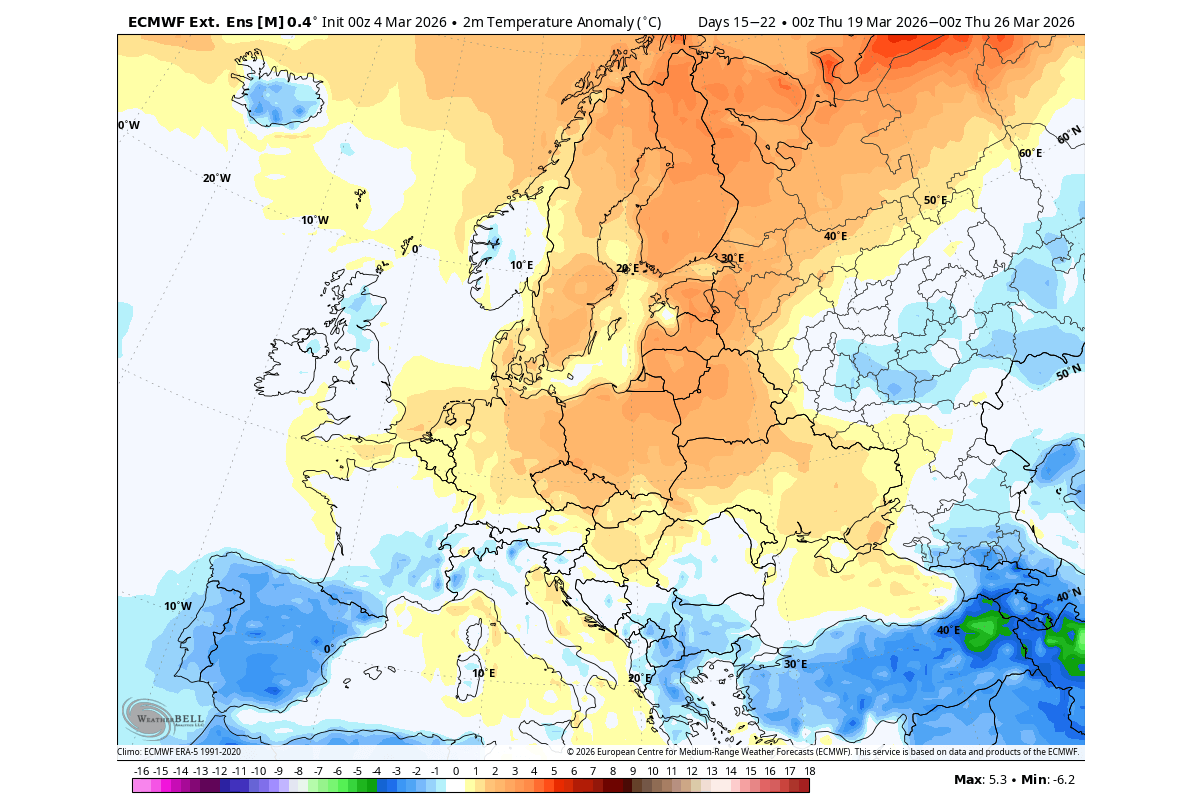
Across Europe, the temperature anomaly forecast for the third week of March shows a warmer airmass over the north-central and northern parts. But as the pressure forecast above was indicating a more split flow, we can see lower temperatures over the central and southern parts.
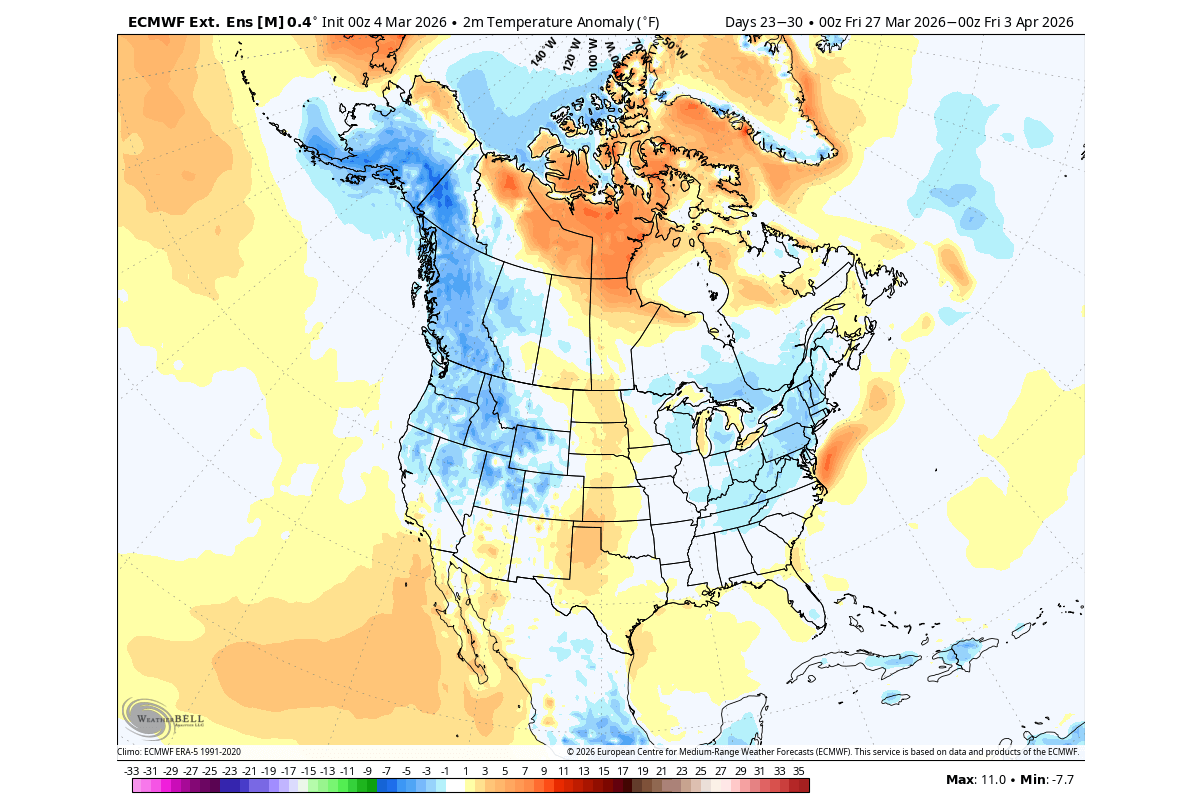
But looking even further into late March and early April, the temperature trends also show a normal to cooler idea over the eastern United States and the northwest. This is something we have seen several times so far, and could also be a signal of a model bias at this range.
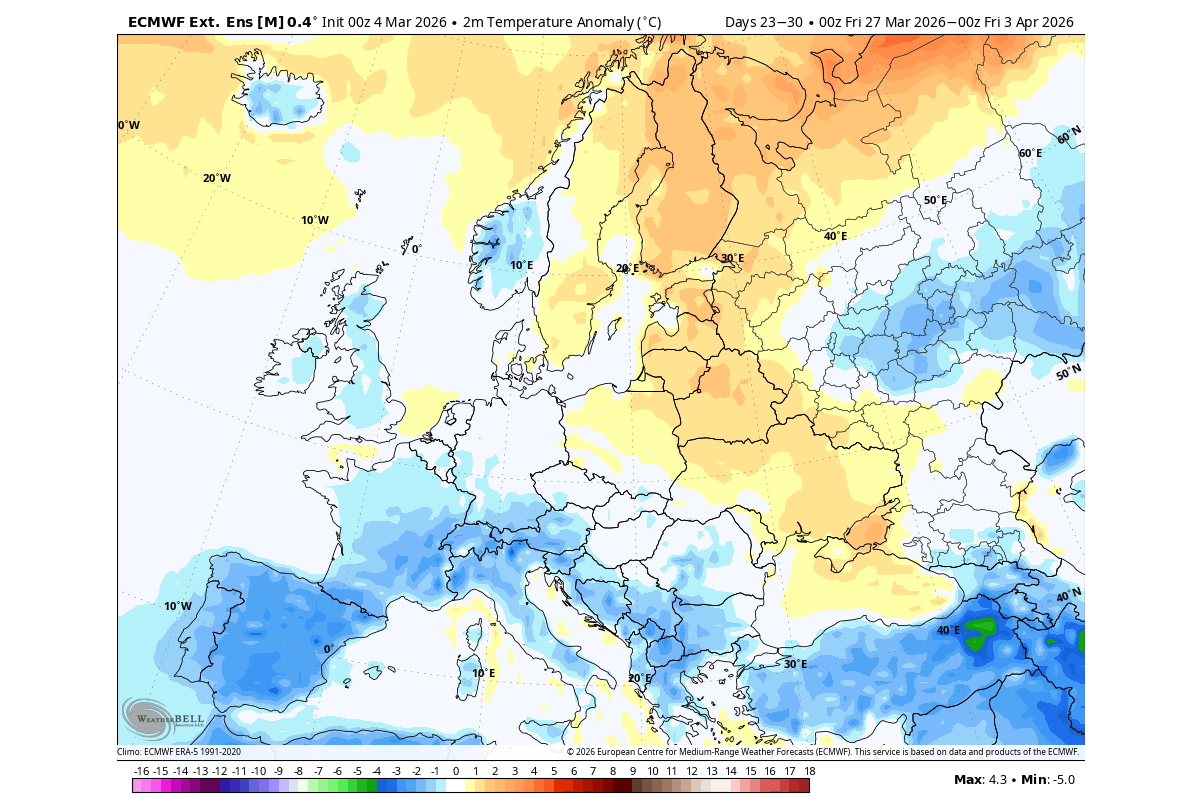
Over Europe, the late March temperature trends show a continued split flow, with the below-normal temperatures spreading further into the western and central parts. This can indicate a stronger westerly or northwesterly flow from the still cool North Atlantic as the weakened Polar Vortex core moves into the area.
This article is based on the latest available model/ensemble data, and we will continue to release weekly updates on this developing Polar Vortex situation.
We will keep you updated on the global weather pattern development, so don’t forget to bookmark our page. Also, if you have seen this article in the Google App (Discover) feed, click the like button (♥) there to see more of our forecasts and our latest articles on weather and nature in general.
The main forecast images in this article are from WeatherBell and weathermodels.com, using a commercial forecaster license.
Don’t miss:
Spring 2026 Forecast: Early Model Trends for the United States, Canada, and Europe