Australia is currently facing a prolonged heatwave that is intensifying as a powerful Heat Dome establishes across the country. As of January 25th, the Bureau of Meteorology (BoM) has issued severe to extreme heatwave warnings for all mainland states and territories. Expecting temperatures to climb up to nearly 50 °C over the next couple of days.
The recent excessive heat that began in Western Australia is now spreading into the southern and southeastern states, with peak temperatures expected between Monday and Thursday this week.
Some high-resolution weather models suggest temperatures could approach 50 °C in parts of inland South Australia, western New South Wales, or southern Queensland during the peak afternoon hours.
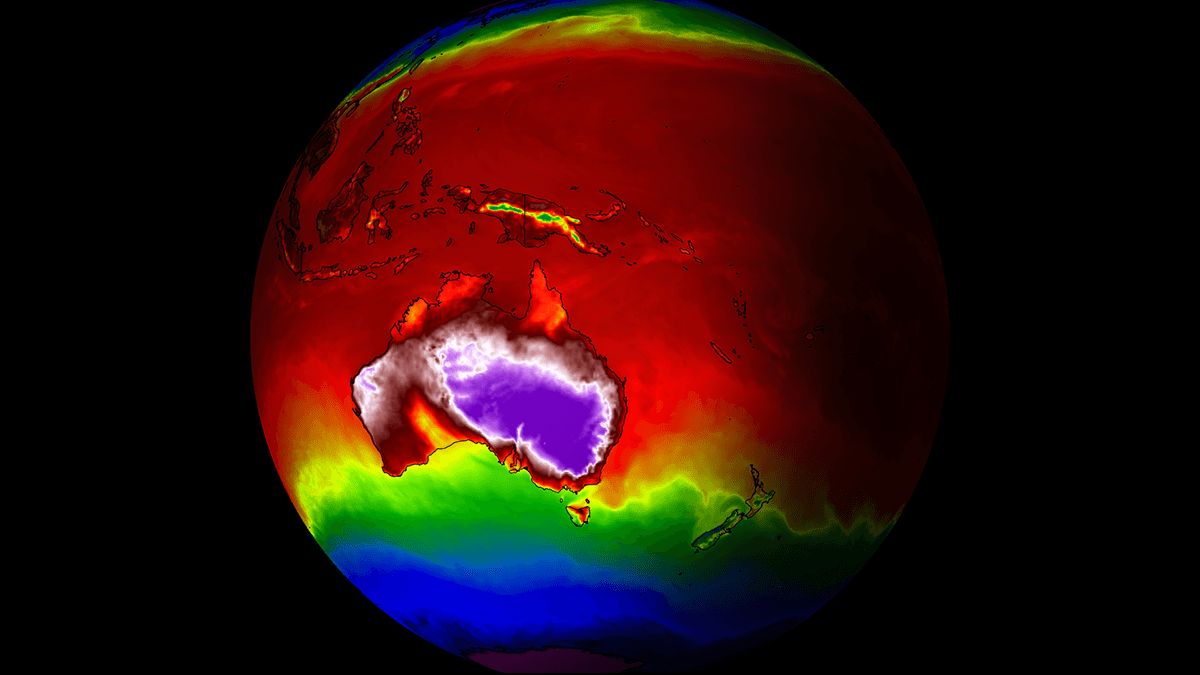
In Northern Victoria, towns like Ouyen and Mildura are forecasting peak temperatures of 47°C to 48°C by Tuesday, which could tie or even break the all-time state records. On Monday, Australia Day, Adelaide is braced for nearly 45 °C.
Further west, the Pilbara region in Western Australia has already recorded temperatures near 49 °C last week, with the 50 °C mark still a possibility in the deep desert in the coming days.
Aside note: these are the highest temperatures ever recorded in Australia:
- 50.7 °C (123.3 °F) – Oodnadatta, South Australia, on January 2nd, 1960
- 50.7 °C (123.3 °F) – Onslow, Western Australia, on January 13th 2022
- 50.5 °C (122.9 °F) – Mardie Station and Roebourne, Western Australia, on February 19th, 1998, and January 13th, 2022
- 50.5 °C (122.9 °F) – Roebourne, Western Australia, on January 13th, 2022
- 50.3 °C (122.5 °F) – Oodnadatta, South Australia, on January 3rd, 1960
- 50.1 °C (122.2 °F) – Wilcannia, New South Wales, on January 11th, 1939
Key Messages
There is a tropical reinforcement in the ongoing pattern, as a unique factor through late January 2026. The Tropical Cyclone Luana made landfall along the Kimberley coast in Western Australia on Saturday. This tropical system is effectively pumping an additional energy into the upper atmosphere, which then reinforces the upper-level ridging (the building heat dome), making it even stronger and harder to move.
The clockwise rotation of the high-pressure system is pulling bone-dry, scorching-hot air from the continent’s center and dragging it down into the southern states (SA, VIC, and NSW). And the heat dome is clearing all cloud cover, allowing no disturbance to the solar radiation.
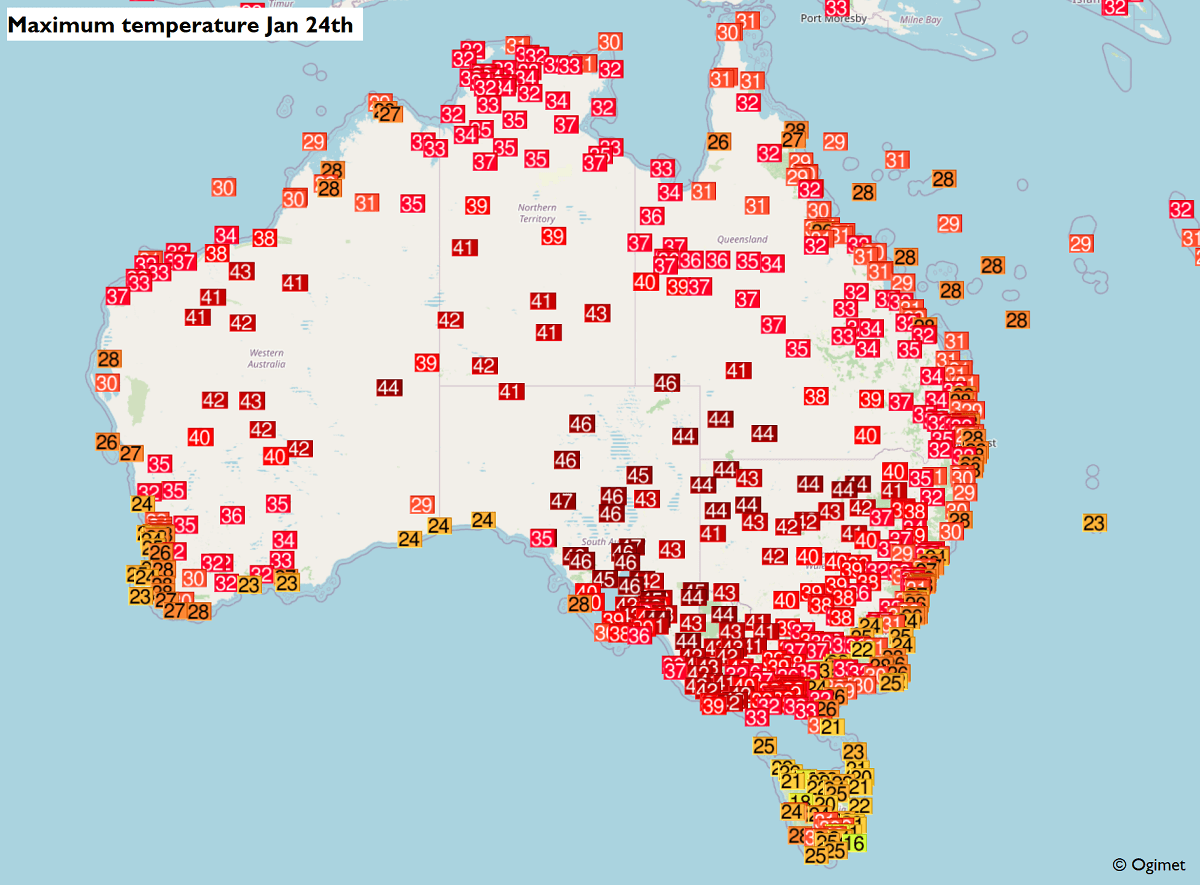
Temperatures have reached 43-47 °C across South Australia, northwestern Victoria, northern NSW, and southwestern Queensland on Saturday, January 24th.
Dry soil is a significant contributor to higher heat as well. Large parts of the interior have seen very little rain in early January. When the soil is dry, the sun’s energy goes entirely into heating the air rather than evaporating moisture. This creates a so-called ‘feedback loop’ in which the ground gets hotter, which in turn heats the air more, which dries the ground further.
ACTIVE WARNINGS
There are multiple Active Heatwave Warnings now, as the Bureau of Meteorology (BoM) has issued warning messages for every mainland state.
The Extreme Heatwave Warning is the highest level of alert. It is currently active for parts of the Snowy Mountains and South West Slopes in NSW, as well as the Northeast Victoria.
Severe Heatwave Warnings are in effect across most of New South Wales, Victoria, South Australia, and parts of Western Australia.
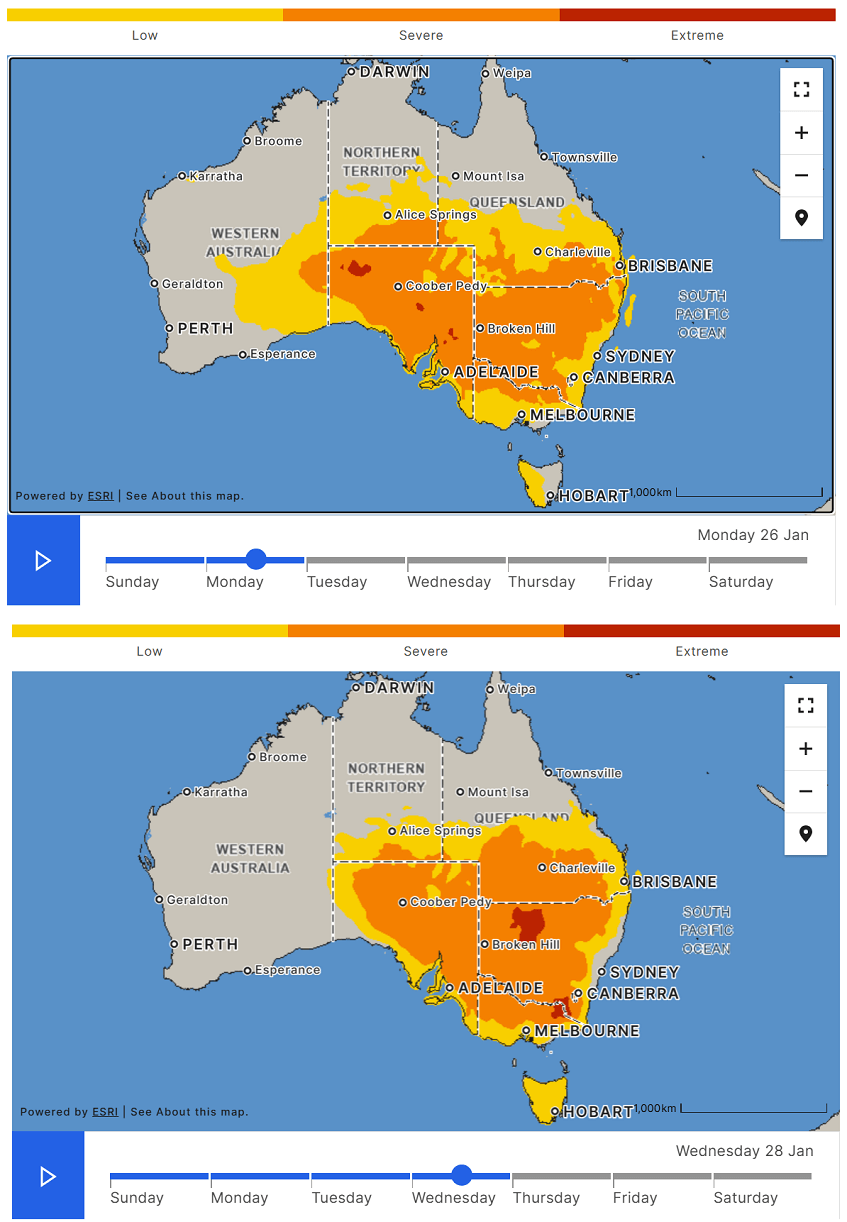
The inland towns of Albury, Wagga Wagga, Mildura, Dubbo, and Tamworth are in the area expected to experience the most intense heat, with temperatures forecast to reach the mid- to upper-40s for several days. There is a possibility that the hottest days will approach 50 °C in some areas.
Fire Warnings
With the Heat Dome and very dry air and soil, the fire risk is extreme and is set to worsen with the incoming winds this week.
A ‘catastrophic’ fire danger ratings have been issued for parts of South Australia and Victoria. Authorities are urging residents to stay indoors, as this heatwave is a prolonged one and is being compared in intensity to the conditions seen during the “Black Summer” of 2019-2020.
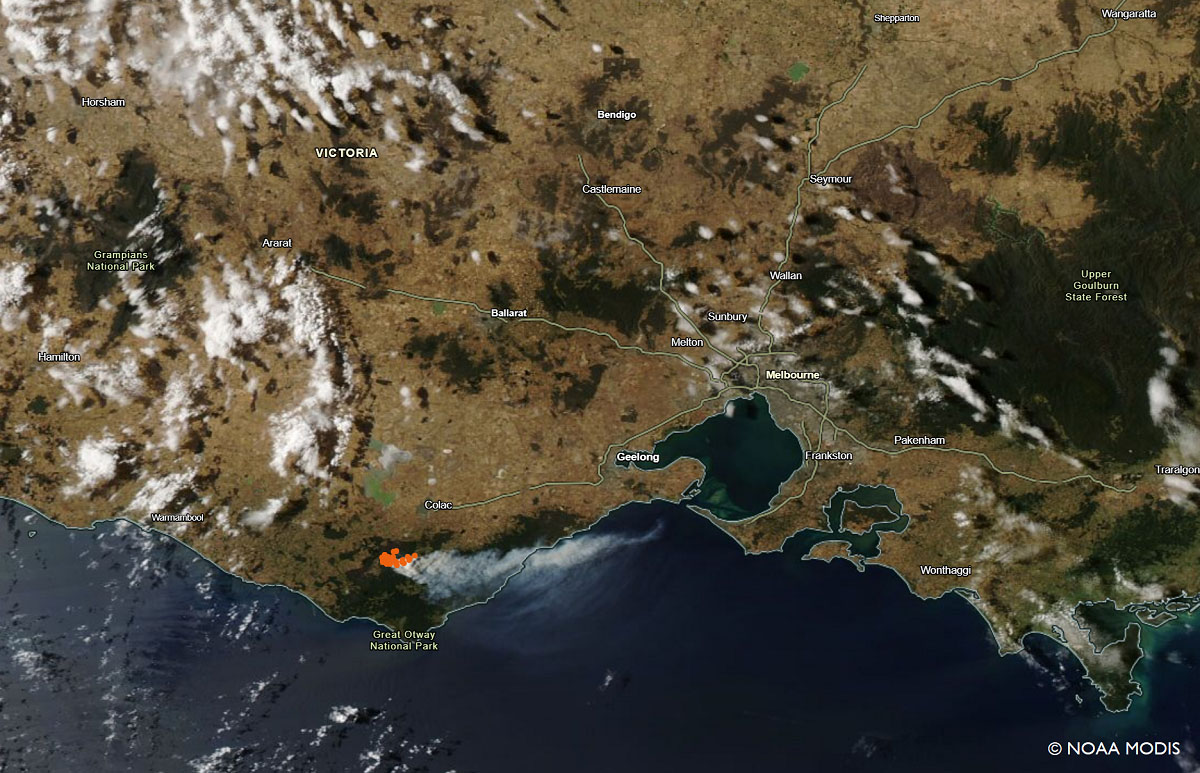
Victoria: A Total Fire Ban has been declared for the entire state.
New South Wales & ACT: “Extreme” fire danger ratings are active for the ACT and Central Ranges (including Orange and Bathurst).
South Australia: Extreme fire danger is forecast for the Lower and Upper South East and the Murraylands.
The current extreme heat across Australia is indeed being driven by a classic Heat Dome configuration, established with an extensive high-pressure system that parked over much of the continent. Meteorologists use this term when an unprecedented and record-breaking heat forecast is expected.
Let’s examine this large-scale feature and why understanding its behavior is essential.
What is a Heat Dome?
When significant and historic record-breaking warm waves or heatwaves occurred in Australia, the United States, Canada, or Europe in the past, the Heat Dome was a contributing factor. The heat dome is usually the dominant feature of summer weather patterns on both continents. But it can occur in the wintertime as well.
We refer to this phenomenon as a heat dome when extremely high temperatures develop. Here’s how it works and why understanding it on a broader scale is essential.
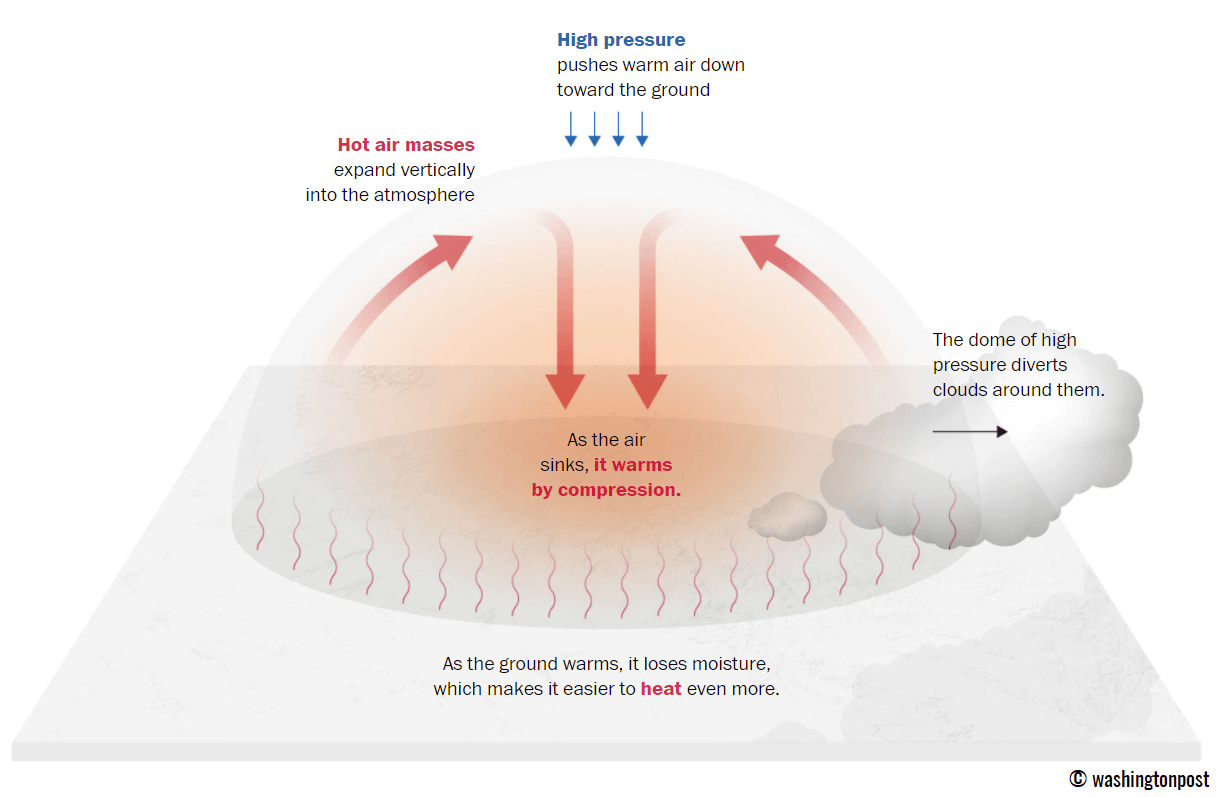
The upper-level ridge pattern, or a very warm air mass at higher altitudes, also known as the Upper High (or blocking High), often forms a heat dome. This weather pattern brings high, sometimes record-breaking temperatures to the region below.
How does a heat dome impact the life underneath?
Excessive heat in heat domes can significantly impact human health and be dangerous to particularly vulnerable populations, such as elderly individuals, children, and those with pre-existing health conditions that can be worsened by extreme heat.
Due to prolonged exposure to high temperatures, construction workers, farmers, and other outdoor workers who work long hours are at increased risk of heat-related illnesses. People living in poverty are also more susceptible to the fatalities of heat domes, as their houses are often built with heat-trapping surfaces such as concrete and asbestos.
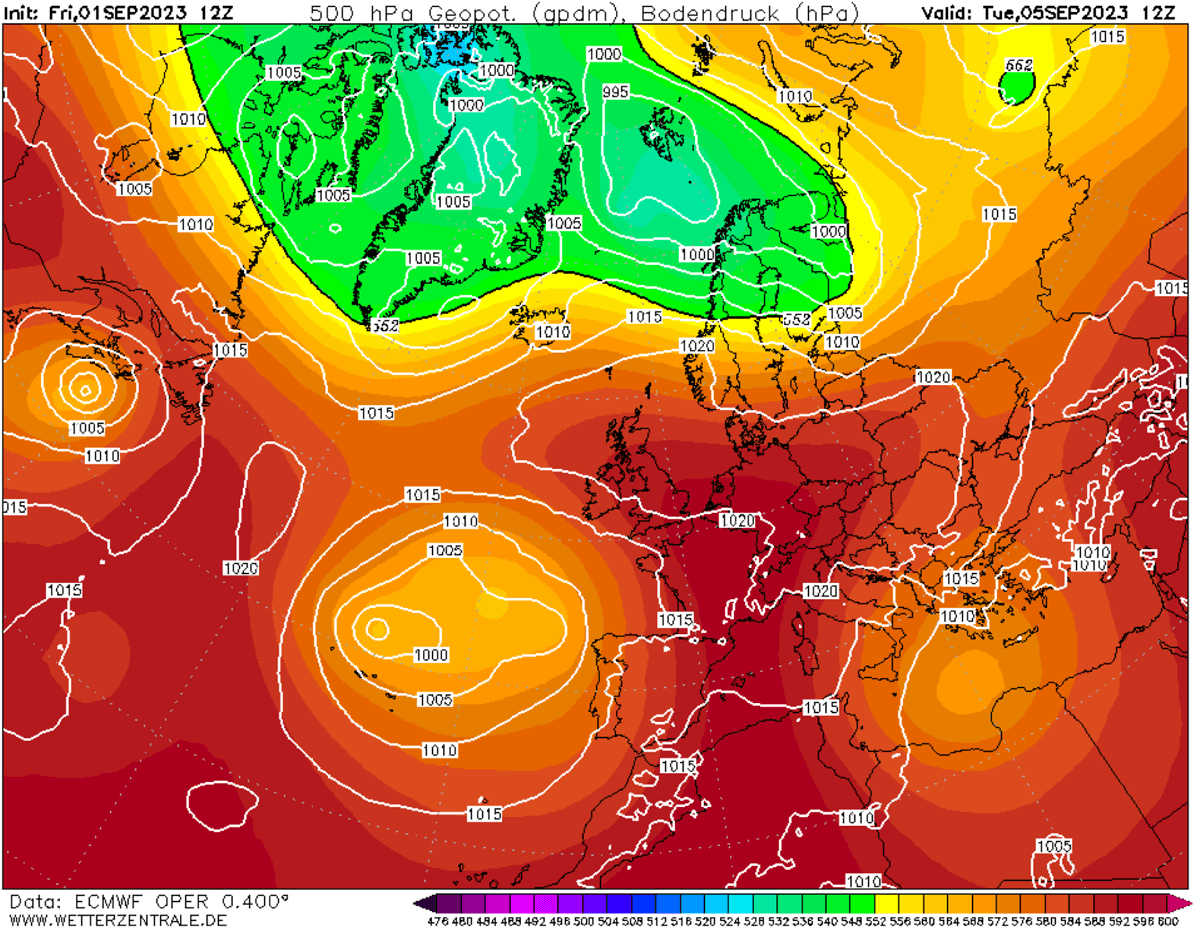
The following chart is a typical example of an Omega blocking pattern when a powerful heat dome normally establishes.
Heat exhaustion occurs upon exposure to high temperatures for extended periods. It leads to dehydration, dizziness, and, in more severe cases, heat exhaustion can progress to heat stroke.
High relative humidity during a heatwave can also significantly affect the body. For this reason, we use a Heat Index to represent the natural feel of scorching hot temperatures and high humidity. It illustrates the natural relationship between temperature and humidity.
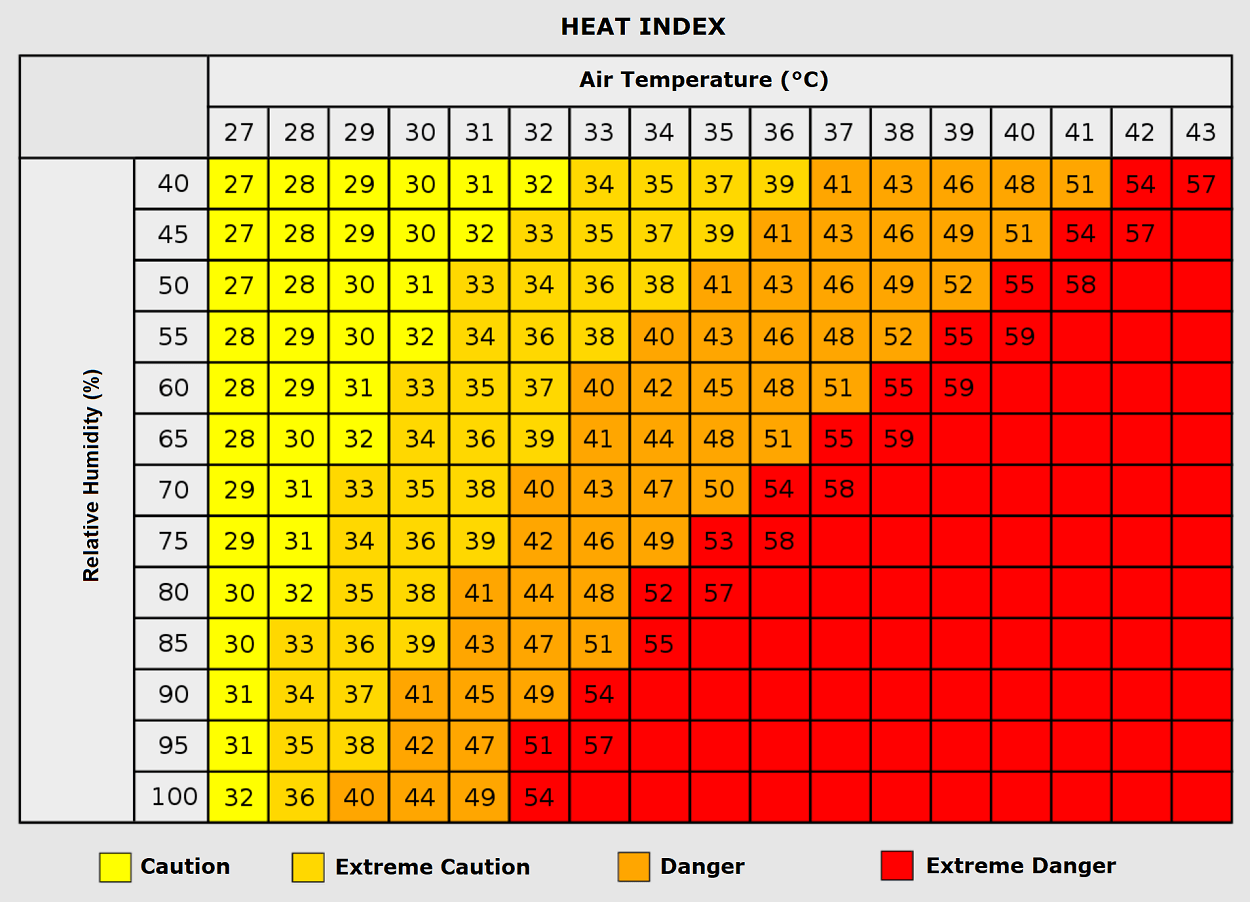
When the air mass has a temperature around +35 °C, humidity below 60 percent is much less challenging than when the humidity is very high, e.g., above 80 %. Thus, the actual feel temperature would be near 50 degrees Celsius.
Heat waves have also been associated with increased rates of heart attacks, strokes, and respiratory illnesses.
Our additional article, Health risks during a heatwave and sweltering hot weather, provides further details on the health risks.
An Omega Blocking Pattern establishes and intensifies the heatwave
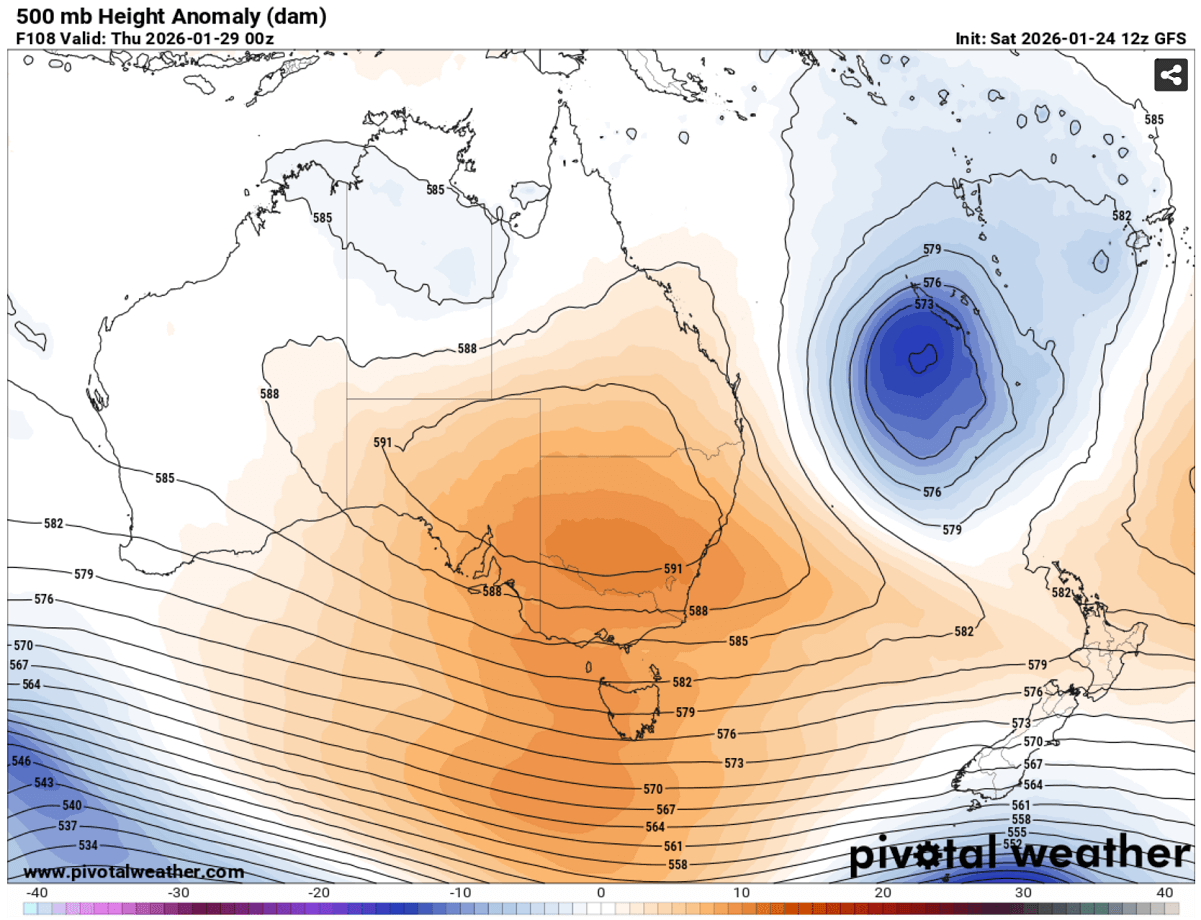
A large Omega blocking weather pattern has established over Australia this weekend. An upper-level ridge is parked across the south, with two deep lows on each side. One is southwest of Western Australia, and the other is towards New Zealand.
This is an ideal scenario shaping up for an extreme, scorching, and potentially record-breaking heatwave as temperatures surge towards the 50 °C mark.
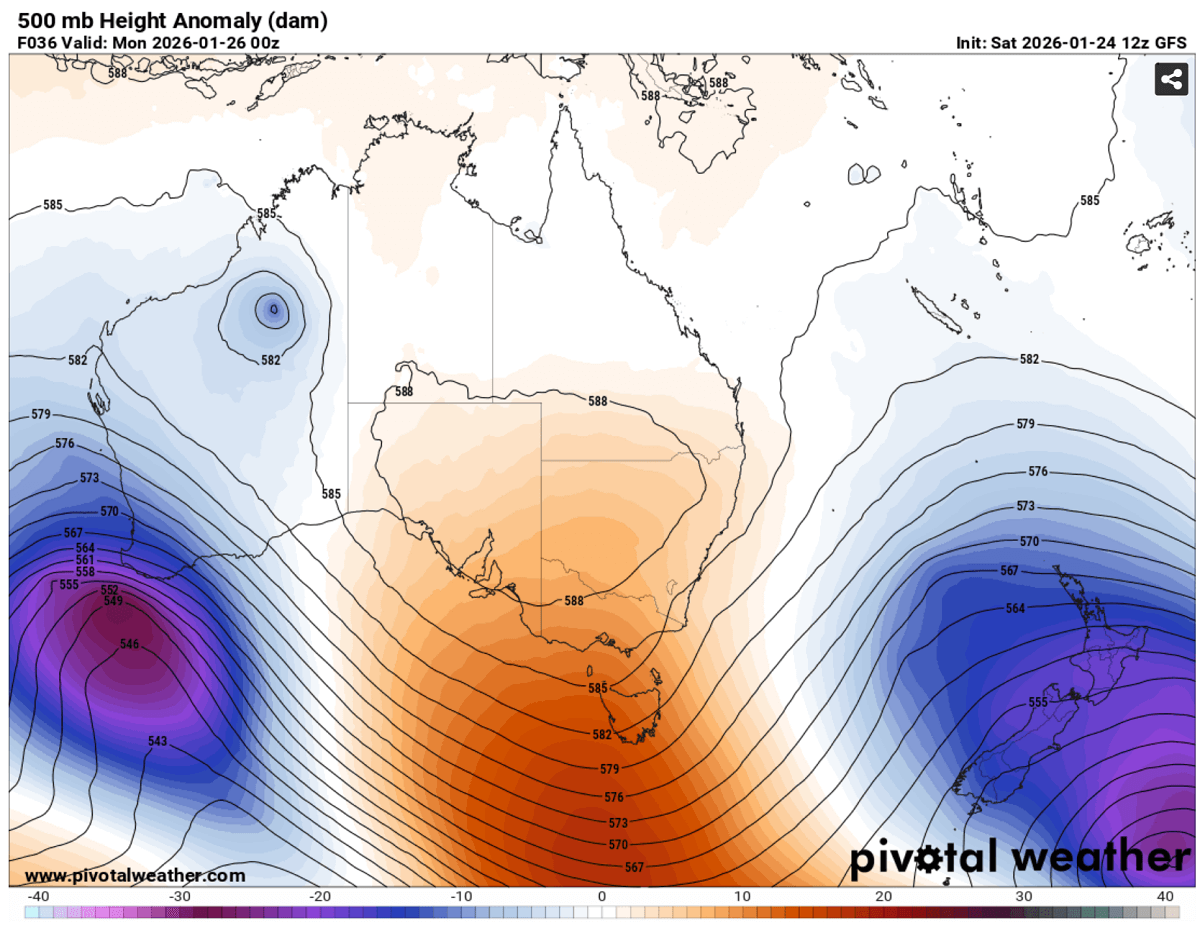
Temperatures are extremely warm across the mid-levels as well, as the heat dome is particularly large and air masses descending beneath it are significantly warming.
This sends temperatures to near 30 °C at the 850 mbar level, which is 15-20 degrees warmer than normal. A potentially historic heatwave will develop over parts of Australia.
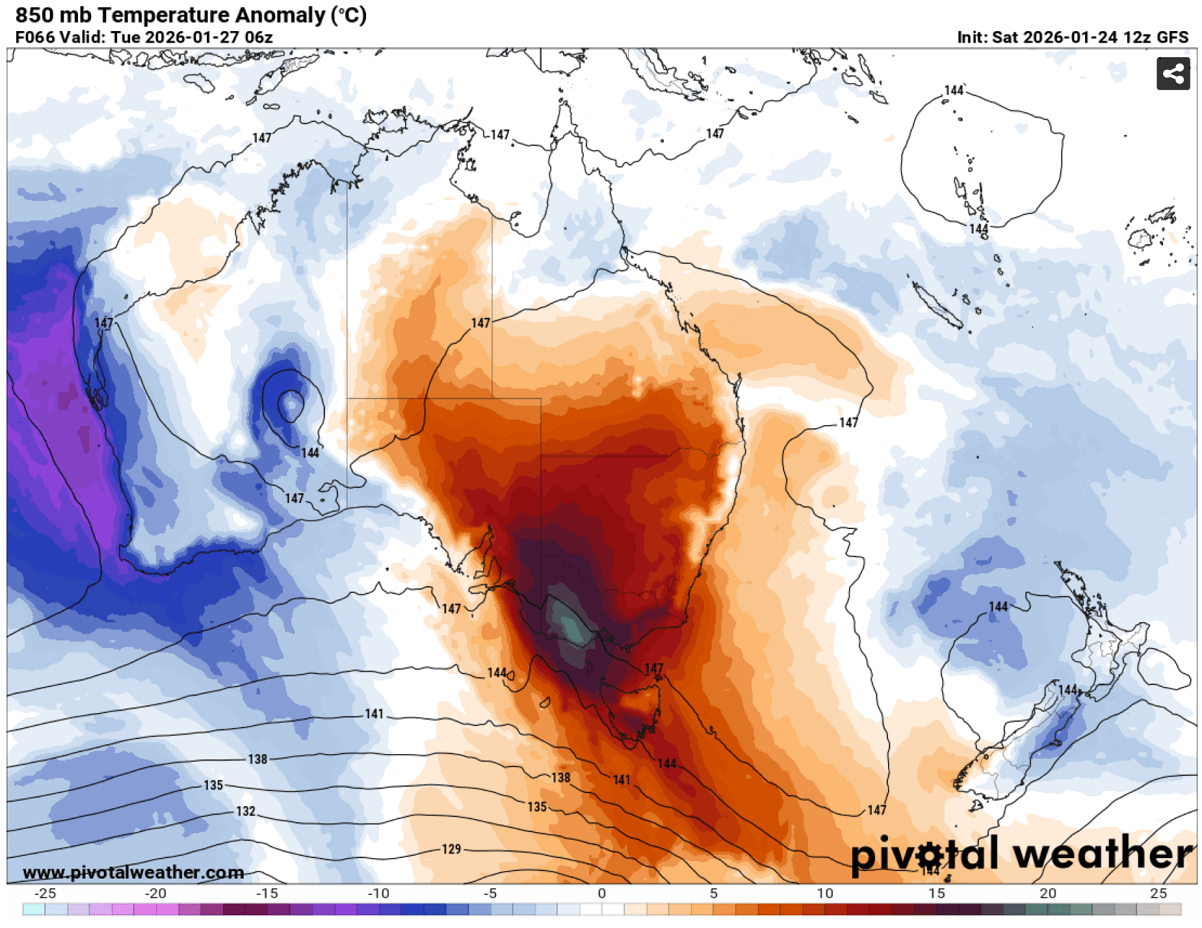
By mid-week, the omega-blocking pattern flattens, and the ridge elongates and expands. And the heatwave grows larger, baking the nation beneath it.
This, however, marks the beginning of the weather change, as the following weekend, a deep wave will emerge from the west, and the ridge will collapse, resulting in a much-needed refreshment for the continent.
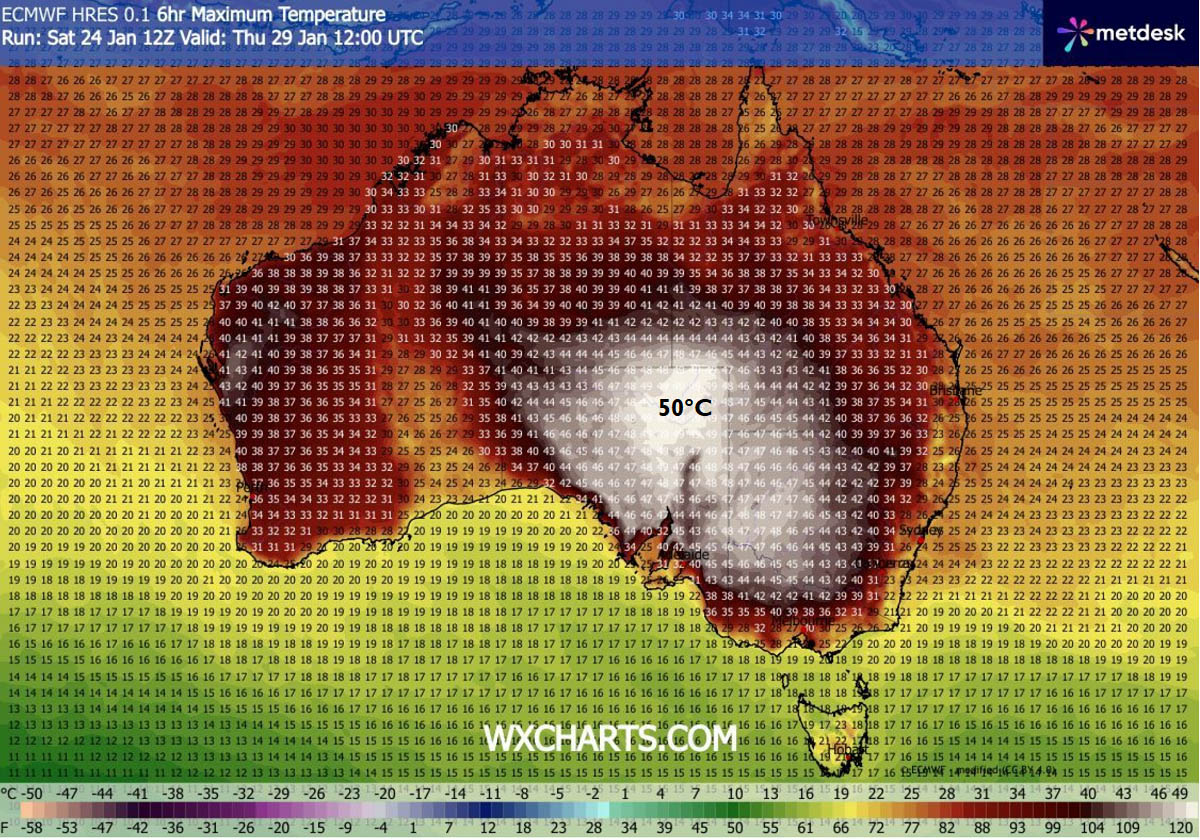
The heatwave is forecast to deliver scorching temperatures across much of Australia through next Friday, with the most extreme heat observed over South Australia, New South Wales, Victoria, and Queensland.
Temperatures will peak in the 45-50 °C range each day and could surpass this mark, challenging some all-time temperature records across the states. Weather models, however, are hinting at the potential for 50+ °C across northeastern South Australia and northwestern NSW.
Here are the meteogram charts for Mildura and Melbourne. Both reveal an impressive, extreme temperature anomaly during this prolonged heatwave. The ongoing Heat Dome will trap the scorching temperatures through the remainder of January.
While the average 850 mbar (approximately 1250m above sea level) temperatures are around 15-17 °C, the upcoming days will bring 25 to 30s °C at this level, which typically happens during the most extreme heatwaves.
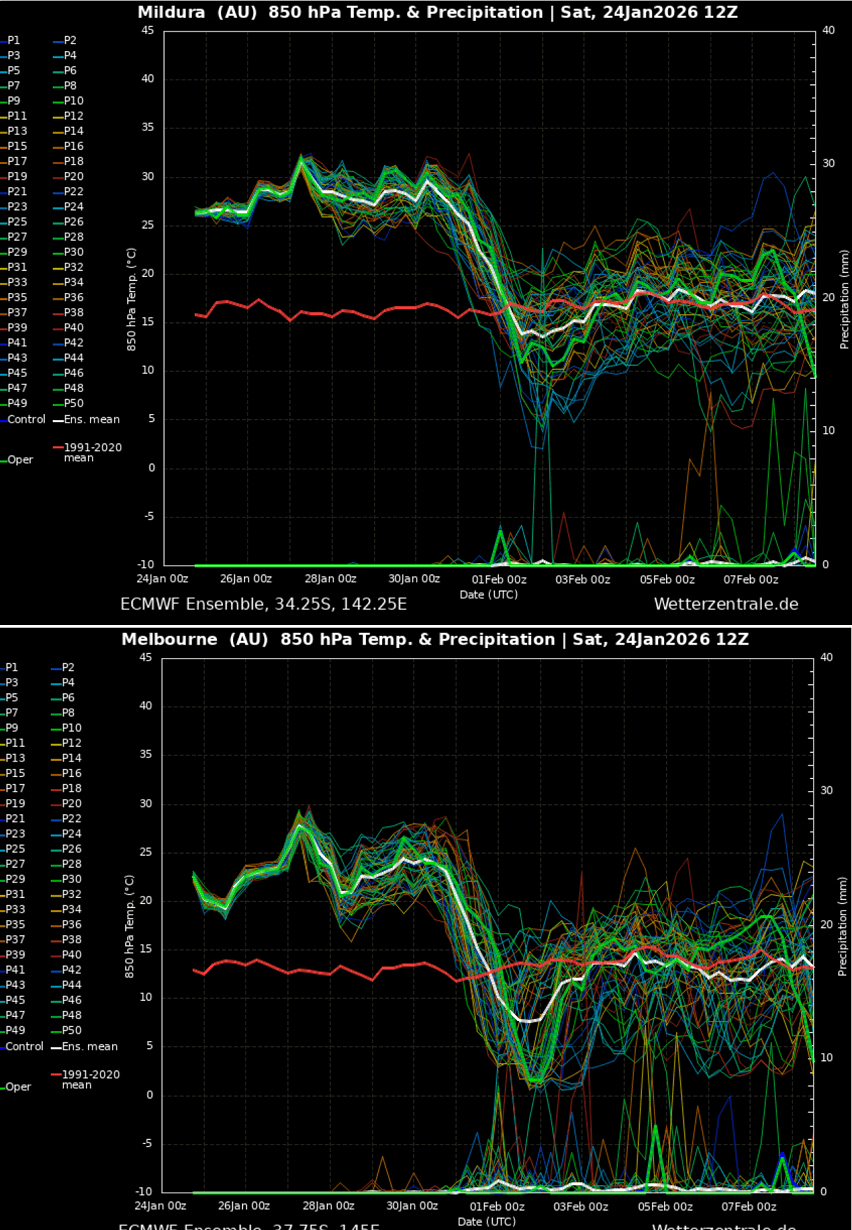
Some refreshment is foreseen as February starts, as a large frontal wave is likely to emerge from the west.
Windy, PivotalWeather, and Wxcharts provided images used in this article.